
David’s songs while running

While David is fleeing from Saul, another man turns against him in Psalm seven. He continues to ask what he has done to deserve death. The new King requests Yahweh to vindicate him. God is his shield and protects him from Saul and those working with him. That is why David praises the Lord.

“The Lord is my light and my salvation—whom shall I fear?” This is the way the twenty-seventh Psalm begins. Many of our problems are because we do not put this fact into operation. Your life shows your beliefs just as this ancient man did. Do you notice that the King refers to living in the Temple of the Lord? I had not been built yet. David referred to it as a real place that he could go to. “Now faith is the substance of things hoped for, the evidence of things not seen.” This is Hebrews 11:1. David did not read it, he lived it.

This shepherd knew to search for Yahweh, and He would find him. He acknowledged that one day he would be with his Lord and savior. Do we stand on that kind of faith?

In Psalm 31 David asks to be delivered by the righteousness of Jehovah, not in his own good works. The rock of refuge and the fortress are names used again here for the Lord. There is a trap set for the King and for each of us as well. We need to plead for deliverance, just as the Psalmist does.

“I hate those who cling to worthless idols”, is a statement made here. Note the difference between the writer and those he refers to. He trusts in God. They do not. Good things will be his after the Lord rescues him from his tormenters. We must hang on until the end, just as King David did.

David continues to praise his God in Psalm 34. Looking to Jehovah to save him is all the young man can do. Try the Lord and see what He will do is the method used here. The righteous are the ones that will be ransomed. Refuge in Yahweh means no condemnation.

Boasting about evil is condemned is Psalm 52. He is speaking of Doeg, who caused the death of the priests and their families because they helped David as he was fleeing Saul’s attempts to murder him. He cannot believe that anyone would violate God’s servants as this man has. The Lord is praised for rescuing our hero even though His own priests were betrayed falsely.

©Copyright 2020 by Charles Kensinger
The family joins David

David is on the run and in I Samuel 21 he stops to see a priest for supplies and weapons. The food is the showbread and the weapon is the sword of Goliath.  Note the presence of one of Saul’s men.  It will be important later.

Ahimelech, the priest, seems frightened to see David alone.  His explanation of meeting his men later does not seem to help.  When David arrived in Gath, he had to act insane.  If they had not thought him crazy, he probably would have been killed.  Was this just David’s ingenuity, or did God give the insight needed to pull it off?

David’s family finds him in hiding in I Samuel 22. Soon he has gathered many of those who were not happy with the current monarch. Four hundred men are with him. Moab takes Jessie and his sons in while David is running from Saul.

Saul is told about the Priest that helped David.  He confronts him and murders him and his family and all the priests in Nob.  Some of the King’s men would not do this but Doag did.  He and Saul now have someone as despicable as himself.

Despite his problems with Saul, David goes against the Philistines in I Samuel 23 to save one of the Israeli towns. After defeating his enemies, he had to escape the village before Saul captured him there. He has another opportunity to speak to Jonathan and is told that his friend knows that the Kingdom is Jessie’s son’s.

He is still being chased.  The King is determined to find him.  Wherever David goes, Saul follows.  The Philistines make another attack and Jehovah rescues the new king before his predecessor can intercept him.

Next Saul goes after his successor with three thousand men in I Samuel chapter twenty-four.  David and his men are severely outnumbered.  They have hidden deep within a cave.  The King cannot find him and stops to relieve himself in a cave.  Guess which cave it is?

David creeps up in the dark and cuts off the corner of his enemy’s robe.  He is overcome with shame for doing such a thing.  He orders the men to not harm Saul.  After the King returns to his men and is a distance away, the former shepherd appears on the mountain and calls to him.  Saul seems genuinely touched.  He acknowledges that his young soldier will become the next king.  He asks for mercy for his family and David agrees.

©Copyright 2020 by Charles Kensinger

Jonathan and David

There has been some conflict in the story of David and Prince Jonathon in I Samuel chapter 18 and following.  Some have attempted to make the affection these men have for each other, as something sexual.  The Hebrew word translated as love has no homosexual connotation.  It goes beyond friendship, trust, and companionship.

Jonathan’s father is not as pleased with David.  Saul attempts to kill him with a spear and when that did not work, he sent him out with a thousand men to attack the kingdom’s enemies.  When that did not work, he offered the first one, then another and when David told others that he did not have the dowry and saw another chance to get rid of him.  The bride price was set at 100 Philistine foreskins.

David could have forced his way because the daughter of the king was one of the prizes for facing Goliath.  The song that the women sang that started the whole thing continued to be heard especially after the cost of the king’s daughter was paid, again.

Jonathan and David discuss the problems with the King in I Samuel 19.  Jonathan knows nothing about his Father’s hatred of the new king.  He tries to make amends between the two.  King Saul reacts to the way his son expects him to, and everything looks fine.  Then on another evening as the young musician is playing for the older man, a spear flies into the wall behind David.  He flees to his home where Micah, his wife, and the princess, helps him escape.

Discovering this deception, Saul accuses her of choosing David instead of her father.  She, like her brother, does not understand the King’s anger with his best soldier.  David escapes to Samuel and as the King’s men attempt to capture him, the spirit of God causes three groups of hunters and even King Saul to speak the word of Jehovah.

“Why is your father trying to kill me?” is the question that David asks Jonathan in I Samuel 20.  The King’s son is not aware of any problem between his friend and Saul.  They put together a plan that will allow the two to communicate again without Saul being aware of it.

It is unusual that the King does not think his enemy is smart enough to know that he is trying to kill him.  Jonathan learns of the anger that has developed in his father.  Saul makes a point of pointing out to his son that Jonathan would never be king if David remains alive.  Despite this, he does not turn on his friend but pledges himself to him again.  He knows that David will be the next king.

Where do you hide when you want to be safe? In Psalm 11 David tells us that Jehovah is his refuge. He knows from experience that there is no place else to hide. He is our one place of safety. Yahweh stays in His temple. This was before there was an earthly structure for His use. Once again, we ask the difference between the upright and the wicked. The righteous are like David and the evil like Saul. Neither one was perfect. Both disobeyed God. What is the difference? David acknowledged his errors while Saul continued to run from his Lord until it killed him.

Have you had a time when you were afraid for your life? That was David in the 59th Psalm. He stayed calm and trusted God although Saul was hot on his heels. The Lord was his strength and protection. He did not want them dead. A difference between followers of the Lord and those who reject Him is shown. Praises are not sung by the lost.

©Copyright 2020 by Charles Kensinger

The final act of defiance

Samuel gives Saul the task of destroying the Amalekites in I Samuel 15.  The King warns the Kenites before attacking Amalek.  Once again Saul does not follow the instructions to the letter.  He brings the king back alive and Samuel must complete Jehovah’s word by executing this man.

They also had saved the best of the livestock.  What was inferior was destroyed per Yahweh’s instructions.  Do you count it as obedience, when only what your children want to do is completed of their required chores?  God doesn’t either.  What have you been told to do by God, that is still incomplete?  Take care of that as soon as you can.

As the prophet turned to leave, Saul accidentally tore his outer garment.  This is an opportunity to once again teach the King a lesson.  Israel has been ripped from his family, just as that coat was rent.  This is the last time these two leaders will meet each other while alive.

The second king of Israel is to be chosen in I Samuel chapter 16.  The town’s people of Bethlehem are concerned when Samuel arrives.  His explanation is that he is there for sacrifice.  Notice the prophet’s response upon seeing Jesse’s son Eliab.  Saul was not chosen by Jehovah for his outward ability or appearance.  The new king has different qualifications from the first.

The new king must be more focused on who Yahweh is.  He must be more focused on others than himself.  Saul’s current problem is his inability to accept that he is no longer the king.  The Israelites believe he is, but God is about to select another.  One of Jesse’s sons has been picked.

It is none of the first seven.  When David appears, he is anointed by the last judge as king number two of the Jews.  What does this mean for David, his family, and the kingdom? Will he claim leadership, or does he have the wisdom to wait for God?  We will see how it plays out.

The spirit of the Lord has left Saul and David is suggested as a musician for the monarch.  Jesse sends his youngest son to serve the King.  When he cannot relax, the boy will play for him.  The spirit has been given to David and his gift of music brings him into contact with royalty.

David is back at home in I Samuel 17 because Saul and the army have gone to fight the Philistines.  Jesse sent his youngest to take supplies to the three oldest boys that are serving in the military.  While there he sees the largest man, he has ever witnessed defy Jehovah and the King’s men.  The young man does not understand why no one has gone to defeat this enemy of Yahweh.

The oldest and youngest brothers have a falling out when the younger tries to find out what the rewards for challenging Goliath will be.  David was more motivated by his desire to honor God, but it doesn’t hurt to know what the pay might be.  Many other things could be looked at including why five stones are mentioned when only one is needed?

Of course, the Philistines do not surrender when their warrior is beheaded.  To the victor belong the spoils, but not easily.  The Israelites chase, slaughter, and plunder their foes.  Another example of Saul’s self-importance is his having to ask others who this young hero is.  His own personal musician should be someone he recognizes.

©Copyright 2020 by Charles Kensinger

Saul’s disobedience

Saul reigned from age thirty until he died at age seventy-two according to I Samuel 13.  The standing army consisted of 3,000 men.  2,000 stayed with Saul and 1,000 were under his son Jonathan.  This would have been later than the first battle of course.

There were 3,000 chariots of the Philistines that gathered to fight them.  Saul was waiting for Samuel to offer a sacrifice.  The king made the offering himself, instead of waiting.    When the prophet arrived, he questioned what had been done.  Saul made an excuse and blamed the people for starting to leave.  He viewed Samuel as being late.  Samuel was following the leadership of Jehovah.  Ministers and other Christians still have problems in this way.  Yahweh sets his own time.

We learn that none of the Israelites have swords or spears, except Jonathan and Saul.  The Philistines have removed all the metal workers and tools from Israel.  This was intentional.  It may explain the Israelite tactic of hiding anywhere they can.

Jonathan’s actions in I Samuel 14 seem unusual.  He and his armor-bearer decide to attack the Philistines.  They have a plan that will tell if God will go with them.  They killed twenty of the enemy in this first battle.

Saul realizes that something is going on and has the troops searched to see who is missing.  When it is discovered that Jonathan and his servant are gone, they determine to join the battle.  Even those who had left, returned to follow and fight the retreating army.

We know that ignorance of the law is no excuse in this country.  Jonathan violates his Father’s order by eating honey.  This causes a mutiny that results in Yahweh withholding an answer from the King.  The lot is cast, and Jonathan is discovered as the sinner.  The pursuit of the Philistines stops because of this.  Who was disobeyed, God or just a man?

This was one of many skirmishes with the different enemies of the Israelites.  Jehovah allows Saul to be victorious despite his impatience to wait for Samuel.  The kingdom will be given to someone else, but until that happens, Saul becomes more convinced that he and his son should continue as the leaders of the kingdom even though Yahweh sees it differently.

©Copyright 2020 by Charles Kensinger

Israel receives a king

I Samuel 9 seems like straying from the previous tact.  We are introduced to the son of Kish from the tribe of Benjamin.  He and a servant are looking for some donkeys.  Jehovah can use even someone looking livestock.  Even Saul recognizes that he is not very important.

Saul is taller than the other Israelites and this will make him a humanly desirable king.  They go to find Samuel, when they are unable to find their property.  Yahweh had prepared this public place for the anointing of the first king.  Samuel does the installation of the monarch, but God chose the man.  Remember that we are chosen for a task by Him.  We should never attempt to choose our own path.

The prophet anoints Saul as king of Israel in I Samuel 10.  The judge also prophesies about what will happen.  The new king and his servant return home and tell a portion of their experiences, but the big man does not mention the oil that he had poured on his head, or his prophesying in Gibeah.  He was touched by the spirit of Jehovah.  He did not tell this to anyone, either.

Samuel comes to Mispah and a sacrifice is arranged.  They are reminded of what they had asked of Yahweh.  The tribe of Benjamin is identified first.  Then the family of Kish is separated from the others and the lot fell to Saul.  He was missing.  When he was found in hiding, they brought him out for the coronation celebration.  His height made many believe he would be a good king.

Everyone left after the festivities ended.  Some brave fighting men went with Saul to his hometown.  There were others that talked against their new king.  This is nothing new, no matter how a leader is chosen.  Someone always is disappointed with everything that is done.

Saul’s strength is being tested in I Samuel 11.  Once again Jehovah’s spirit comes on him.  Jabesh-Gilead is under attack by the Ammonites.  Their plan was very sneaky.  The Israelites were afraid they could not resist.  Their stalling tactics worked, and the new king of Israel gathered the fighting men and rescued their brothers.

At this time, they renewed the commitment of the young monarch.  This is just the first of the battles that will establish the kingdom.  Life will change for the entire country as Samuel’s predictions of the consequences of appointing one ruler for life.

In I Samuel 12 Samuel says, “Now you have a king as your leader.”  The last judge was a man who never defrauded anyone.  Unlike many others in leadership then and now, he was a man of integrity.  The prophet warns them a last time of all that is required of the Israelites.  God is still the one they should follow and no one man.

“Do not turn away from God.” That is a reminder that we all need.  Today, despite our salvation being bought and paid for by our savior, we must continue to follow in obedience to Jehovah.  Samuel gives this word not just to the Jews of his day, but to us as well.

©Copyright 2020 by Charles Kensinger

The Ark is captured and returned

The Philistines continue to be in control over Israel in I Samuel 4. They gather for another battle, but once again the Jews are defeated. They try again with the Arc of Jehovah. The Arc is not a talisman, but the symbol of Yahweh’s presence. God was not consulted. No one seemed to take the time to seek His advice.

The presence of the Arc caused joy in the Hebrew camp and fear in the Philistine. The hunkered down and again chased Israel away. Phinehas and Hophni, Eli’s sons, had gone with the Arc. During the fight, they were killed. Upon hearing the news, Eli fell over and broke his neck. Phinehas’ wife gave birth after she heard of her husband’s death. The boy lived and his mother died. Samuel becomes the chief minister at the Tabernacle.

In I Samuel chapter five we hear about the god of the Philistines falling and worshipping Jehovah on two different nights.  Tumors break out in the city where the Arc is taken.  Even though they do not know Him they believe He is the cause of their disease and death.  They send Him away by removing the Arc.

The same thing happens in the next city.  An outbreak of tumors kills many and others just die.  Once again Yahweh is forced from their community.  The city refuses to allow the creator of the universe entry.  They demand all the leaders of the Philistines gathered to determine what to do with the presence of such a powerful being.

Have you decided about who He is and whether you will accept His Son as your Lord and Savior?  The Philistines could have fallen on their faces as their god Dagon had done.  Had they asked for forgiveness and became a friend of Jehovah and His children, they could have been forgiven.  Ruth and many others we have read about and will encounter further in the Bible chose this path.  It was and is available for all.

I Samuel 6 tells us after seven months that a decision is finally made to return the Arc to Israel.  The plan is clever.  It also includes a method to discover if Yahweh is the one causing these circumstances or if it is just bad luck.  The cows should turn toward their calves.  They did not.

Beth-Shemesh is the Hebrew city that receives the presence of the living God.  They rejoice at first and use the two cows and the cart as a burnt offering.  They even had Levites remove the Arc from the cart because only this clan was to carry the symbol of Jehovah.

Later, some in the new hometown of God are struck down because they opened the Arc to investigate it.  Touching the container seems inconsequential.  How can it be worth their lives, just to have touched a box?  God sets standards.  It is our task to simply obey.  We all know that is impossible for us humans.  Once again God is rejected by those who refuse to respect Him.

Aminadab agrees to house the Ark of the Covenant in I Samuel 7 by consecrating his son to be pure in the sight of the Lord.  Someone had to do this to qualify to approach the presence of Jehovah once a year to present the sacrifice.

The Israelites decide to follow Yahweh while Samuel led them as their prophet and judge.  The Philistines attacked them during their worship.  They were defeated and all the Jews had to do was chase them as they fled.  Peace came to Israel and the surrounding countries that had been ruled by the Philistines.

The same problem that afflicted Eli is presented in I Samuel 8.  Samuel’s two sons do not follow his example as a leader or a follower of Jehovah.  A group of the leaders of the twelve tribes ask him to appoint a king.  They do not want to rely on those that will inherit rule.

This seems incongruous.  A monarchy is based on succession by family.  This is the reason our country chose not to create a monarchy.  The only way to remove a king or queen is through a revolution.  Violence is no way to run a civilized country.

Samuel warned them what a monarch would mean for all of them.  They would lose their children, property and civil rights.  The king would do whatever he wants to do to them.  They knew what other kings did to their people, but still wanted their own king.  Tomorrow a king is anointed.

©Copyright 2020 by Charles Kensinger

Samuel’s Birth

Samu

el’s birth and call to ministry

Every minister must start somewhere and I Samuel chapter 1 is his beginning as a baby.  He became more than the last judge of Israel.  He was a prophet and the one who anointed the first two kings.  But first, he had to be born.

Hannah was childless.  This was nothing that was unique to her.  It frustrated her more than anything.  She agreed to give her child to Jehovah if he would only grant her desire.  The priest at the Tabernacle thought she must be drunk because when she prayed her heart was broken to the point, she could not vocalize those feelings.

After Yahweh granted her wish, she did not return to Shiloh until the child was old enough to be left with the priest, Eli.  What could a young boy do for God in the place where all the Jews came to worship and sacrifice?

Hanna prays in I Samuel 2 thanking Jehovah for her son.  She proclaims there is no other God.  He is the one who directs everything.  The justice of Yahweh will prevail.  The boy is left with Eli the priest.

The priest has two sons who are not very good as priests.  They have no concern for the people and are only interested in themselves.  They take what they want whether it is the women outside the tabernacle or the best part of the sacrifice.  Samuel sees all this.

A prophet comes and tells Eli that God will soon pass judgment on him, his sons and his entire family.  There will be a new prophet chosen to lead Israel.  He doesn’t name Samuel, but the description fits the boy when he is grown.

Samuel’s job in the Tabernacle was to assist Eli and his sons.  In I Samuel chapter 3 we read of the first message Jehovah gives to the boy.  He hears someone calling him three times and finally, Eli realizes that God is calling him.  Following the advice of the priest, the next time his name is called, the young judge responds positively to the Lord.

What will happen to the current family of priests is given to the young man? He reluctantly tells his mentor the next morning.  As Samuel grew, he was recognized as a prophet by Israel.

©Copyright 2020 by Charles Kensinger

A Moabite and her mother-in-law

Ruth is a short book that seems at first to be a diversion between the books of Judges and First Samuel. Judges establish the anarchistic form of government that Israel had fallen into. Everyone did what they pleased when there was no Judge from Jehovah in leadership. The books of Samuel introduce the Kingdoms of Israel and Judah. Ruth shows us that Yahweh is still working for what needs to happen even before we realize. This story was probably recorded in writing during the reign of King David. We will discuss that in the conclusion.

The little book of Ruth is a diversion. It is history, like Joshua and Judges. It is about a woman and she is a Moabite, not a Jew. It takes place during the time of the Judges. Let’s look at Ruth and why she is important in Hebrew history.

In the first chapter, Elimelek and Naomi move from Bethlehem to Moab because of a famine. They had two sons, Mahon and Kilion. After the death of their father, the two boys marry women from the area. Their names are Orpah and Ruth. After about ten years, Naomi’s sons also die, and the women are left alone.

The matriarch determines to return to Bethlehem and the daughters-in-law are preparing to join her. Naomi tells them they are free to stay in their homeland and marry men from there. Orpah stays, but Ruth makes a statement that is used in many wedding ceremonies. “Where you go, I will go. Where you stay, I will stay.  Your God will be my God and your people, my people. Where you are buried, I will be buried.” This sentiment is wonderful for a couple being married.  But it was originally spoken by a woman to her mother-in-law. That tells us about both women.

More things to notice in the story are, Naomi changes her name to one that means bitter.  Naomi means pleasant, which she must have been, or these two women would not have hated to leave her. Often, outward circumstances affect our entire outlook on life. If we recognize that we are in a time of preparation for a great blessing, it can make the depression and sadness easier to manage.

It is also time for the barley harvest. At the beginning, this seems like an irrelevant statement. We will see just how important this is.

Boaz is introduced in verse one of Ruth chapter 2. Ruth goes into the fields to collect the grain that the harvesters leave. This practice is commanded in the book of Leviticus. When she returns to their home, her mother-in-law tells her that the owner of the field is a relative.

The property owner has made concessions to her that were not normally seen. He is impressed by her love for his relative. She does not understand his kindness. How often has this happened to you? Has anyone ever shown a kindness for reasons you did not understand at the time? Has your kindness been shown to a stranger for a reason they do not understand? Christians always have a reason to serve others. It is what He did for us. Stay tuned for the best part.

Naomi becomes a matchmaker in Ruth chapter three. She explains the kinsman redeemer as written in Leviticus and Deuteronomy. Ruth goes to the threshing floor and lies at Boaz’s feet. When he wakes in the night, he enquires who is there. They discussed the possibility of marriage. He assures her that he will take care of her. His first step is to prevent the scandal that would be caused if she is found there with him. He also gave her grain as a gift for Naomi. What are your feelings about this conversation?

Ruth 4 completes the story and at the end we learn why this is part of the historical record of the Israelites. Boaz finds the other relative of Naomi’s husband. He tells him that the land is available for purchase. A wealthy man as well, he instantly agrees. The agreement includes producing an heir for Mahlon, the husband of Ruth. Any heir produced for a dead man, would also have a right to his own property. Boaz has no other children and does not see a problem with raising Ruth’s first son as an heir to his and Mahlon’s estates.

Ruth does become pregnant after the marriage. Her son, Obed, is the connection that puts this account in the Old Testament. He is the grandfather of King David. That makes Ruth the Moabite the great-grandmother of the greatest king to ever rule in Israel. She is also an ancestor of our Lord Jesus Christ, the Messiah of the Jews. Tomorrow the birth of the final judge of the Jews.

©Copyright 2020 by Charles Kensinger

A shocking sexual assault

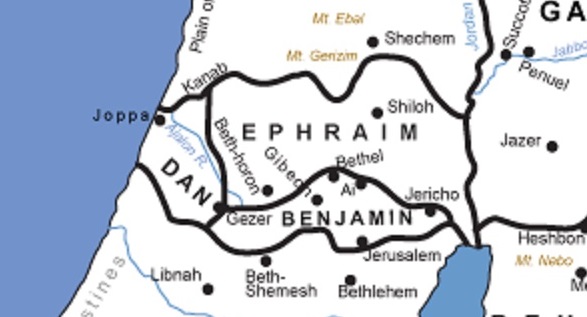
Dan Benjamin Ephraim

Judges 19 starts with the statement that Israel did not have a king.  The king was the one that would enforce the law given by Jehovah.  The people are the ones that should keep the statutes without a leader forcing them.

A Levite from the hill country of Ephraim took a woman from Bethlehem to be his wife or concubine.  For some reason, she leaves him and returns home.  As with ministers today, their lives were not perfect.  He goes after her and the actions of her father are interesting.  He delays their departure as much as he can.

When they finally leave, it is late, and they stop for the night in Jerusalem.  During the night some of the citizens want the Levite to have sex with them.  He finally pushes his wife out to them.  She is raped and eventually dies.  He dissects her and sends the twelve pieces to the leaders of each of the twelve tribes.

Four hundred and fifty thousand troops come to see the Levite after they receive the packages.  In Judges 20 they inquire about what this means, and the story of the rape and murder is shared.  The decision is made to attack the city.  The Benjamites are given an opportunity to turn the offenders over to the other Israelites, but they refuse.

It takes three tries and the Israelis seek Yahweh’s will and are assured that they are following what He wants.  Ultimately the village and most of Benjamin was destroyed.  This leaves a situation of one of the twelve tribes facing extinction.

The solution to this delima is in Judges 21.  All that remains of Benjamin are some men that had hidden during the massacre.  The other tribes had pledged not to give their daughters to them for wives.  One group of Israelites had not participated in the destruction of Benjamin.  The others decided to destroy all the men, married women, and children.  That left four hundred young girls which they sent to the Benjamites.

That was not enough.  A decision was made to allow them to kidnap some young women during a festival.  Time after time they seem to ignore common sensibilities in favor of honoring promises they made to Yahweh that never should have been made.  Judges ends with the statement once again that there was no King in Israel and everyone did what they thought was right. We call this form of government anarchy.

©Copyright 2020 by Charles Kensinger