
The broken record in scripture

Deuteronomy 13 6-8

The Lord reminds the Israelites in Deuteronomy 11, of all the things that He has done for them.  The promise of Jehovah to give them a land that will grow plentiful food for them and their descendants is just one.

A warning is given again to obey Him and that if they do not, they will not be blessed in the way that has been promised.  There is a blessing and a curse included here.  They must remind themselves and their children each day of who Yahweh is and what He wants them to do in the law.

Deuteronomy 12 tells specific ways to keep from falling into the worship of other gods.  Putting your faith in Jehovah is an action you must take.  He will choose a place of worship.  This is the worship center.  Not a single temple or high place for another god is to be converted to His worship.  When the early Christian church became the national church of the Roman government, many festivals and holidays were changed to Christian holidays.  Christmas, Easter, and Halloween are three.  We must separate the holy from the unholy because of this.  That is why Christmas and other holidays are more secular than they are holy.

The priests who were descended from Levi must be taken care of.  They would not have land to inherit.  Their legacy was the service to God.  The blood is pointed out as the part that has life in it.  Blood is not to be eaten or drank.  Other laws are not to be added unless specifically given by God.

Following other gods seems to be a broken record in Deuteronomy 13.  Here we see that prophets or dreamers who try to direct the Israelites to other deities are to be executed.  Family relationships are not to deter them from dealing with anyone who attempts to draw them from Jehovah.

Yahweh is serious about not worshiping anyone but Him and instructs the destruction of an entire town if it follows a worshiper of other gods.   By stopping individuals or groups from falling into idolatry the nation can be saved from the tragedy of being rejected by The Lord.  As we will read later, they did not obey these commands and suffered the consequences.

©Copyright 2020 by Charles Kensinger

People do not live by bread alone

Deuteronomy 8 3b

Deuteronomy 8 is the first place we read “People do not live by bread alone; rather, we live by every word that comes from the mouth of the Lord.”  This is the scripture that Jesus quoted to Satan when He was tempted to turn stones into bread.  God will discipline them and us just as parents discipline their children.

Jehovah will provide a good life for them.  That will also be a problem.  A life of plenty will lead them to believe they are entitled and deserve everything they have.  That is our problem, in the United States today.  We are affluent and believe affluenza is an excuse for our children disobeying.  Yahweh tells us it is not.

In Deuteronomy 9 the Lord tells the Israelites that they will soon go into Canaan and conquer the Anakites and all the other people groups no matter their strength, power, or protection of the cities.  When this happens, they should not believe that God did this for them because they are better than others.  The reason they are given the land is because of the wickedness of the current inhabitants.

Moses reminds them of the times they have failed Jehovah and he has had to plead on their behalf.  The Jews were like we are.  We say we will follow Yahweh, but constantly break His laws in some of the worst ways possible.

Deuteronomy 10 rehearses the origin of the Ark of the Covenant and the separation of the Levites. This is necessary because for the last forty years those who witnessed this have died.  Their children and grandchildren are now ready to enter the promised land.  They are reminded of what their ancestors knew and had done.

The Jews are again commanded to obey The Lord’s laws and statutes.  They are instructed to take care of widows and orphans and to be kind to the foreigners that come to their land.  They were strangers in a land not their own.  Israel should set the example of what a truly holy people can be like.  Jesus told His followers to become what the Jews could never accomplish.

©Copyright 2020 by Charles Kensinger
Teaching the Law is important

Deuteronomy 6 4 5 002

Deuteronomy 5 is a rerun of the Ten Commandments.  These are often thought to be the ten most important laws.  They should be viewed as representative of what Jehovah wants us to do.  God is the only being that should be worshiped.  His name should be respected, and no false gods should be created.  The Sabbath day of rest is another way to honor him.

The fifth commandment and further establishes the order in the family with the children’s respect for their parents. Other laws of personal behavior are enumerated.  Murder, theft, adultery, false testimony, and coveting establish conduct that shows love and commitment for others.  Following these instructions are necessary for a civilized society.

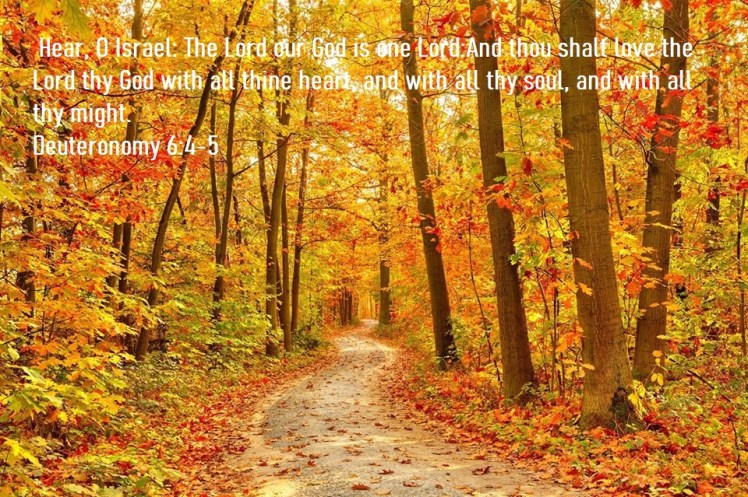
Deuteronomy 6 tells us “If you obey all His decrees and commands, you will enjoy a long life.”  This is the dilemma of all humanity.  We must obey all the laws with no mistakes.  No one can do that.

To remind themselves and their children of these laws they are to teach them to their children, talk about them all day and night long, write them on their clothes and walls.  As Christians, we must do the same.  Sunday School, Bible studies, Bible schools, Christian camps, T-shirts, and wall plaques are all ways we try to accomplish this.  This daily Bible reading is another way to bring God’s word into you.

The repetition may seem overkill, but we need the reminder often.  We must constantly remind ourselves of what Jehovah promised first the Jews and now us.  When we forget about Him, we will fail Him and ourselves.  Our sins are forgiven, but we want to be as faithful as we can.

The promise in Deuteronomy 7 is that Yahweh will enter the promised land ahead of them and drive out the current residents.  All they must do is remain faithful to God and He will provide for them.  Simple isn’t it.  Yeah, right.  They are being rejected because they have refused to acknowledge the Lord.

This also happened to Israel and can happen to us.  We must follow God and not just obey man-made rules that sound good to us.  We must listen to Jehovah, not our culture, ministers, parents or other leaders.  We are individually responsible for our own behavior.  God will bless us.  That blessing may not follow our desires, but His.

©Copyright 2020 by Charles Kensinger

Reviewing the Law of Jehovah

The Deja-vu continues in Deuteronomy 3.  The land of Og is taken as was written in Numbers.  These were some of the tall men that are called the Raphaites.  We are rehearsing the taking of the country before they crossed the Jordan.  We see again how Jehovah makes it possible for them to defeat those that appear physically stronger than the Israelites.

Moses will see the promised land from the mountain.  He will still not be allowed to cross over into it.  This was because of his disobedience with striking the rock to bring water for the Jews.

The instructions in Deuteronomy four are to obey and not add to or subtract from Yahweh’s law.  The Jews are different from every other nation in the world.  Their gods are not close to them as Jehovah is to the Hebrews and now Christians.

The laws that Jehovah has given them are to be honored.  All the law, not just the ones that they want to obey.  They are to be handed down to their children.  Idolatry is specifically mentioned as a threat to the Hebrew nation.  They are warned that they will be removed from the land if they do not obey Yahweh’s commands.  The interesting thing is that in the books of Kings, Chronicles and the prophets we will see this prediction coming to fruition.

The cities of refuge east of the Jordan are specified. The Land of Canaan will be established as the only place in the world where God’s laws are followed and no worship of any idol or false God will be accepted.  It may not be Heaven on earth, but it should be much better than anything seen before.

©Copyright 2020 by Charles Kensinger

Moses’ last days

Deuteronomy 1 8

God is ready for the Israelites to enter Canaan in Deuteronomy chapter one.  Moses reminds the leaders that were chosen to help him for settling disputes in each of the tribes.  He continues with the history of the last forty years.  Including the twelve spies that were selected and sent out to scout the land and the rejection of Joshua and Caleb’s recommendation to enter the land.  After the rebellion and Jehovah’s punishment, they attempt to enter after they are told they will wander for forty years.  Have they learned anything over those years?  We will see tomorrow.

Deuteronomy 2 tells how the Israelites passed certain nations to go into Canaan.  The lands of Edom, Moab, and Ammon are not to be conquered.  The Amorites were not as fortunate.  Their nation was defeated because Jehovah had decided to give it to the Jews.  This is the same thing we read at the end of Numbers.  The Lord had His own reasons for which of the countries could be conquered and which were left alone.  He also had a plan for repeating the stories in these five books.  As with the rest of the Bible, Yahweh wants us to understand what He is attempting to teach.

©Copyright 2020 by Charles Kensinger

The cities of refuge

Numbers 36 13Preparations must be made for the move into Canaan. Numbers 35 tells of the cities that are to be established for the Levites. Six of these are to be cities of refuge. These cities are the ones that a person may go to in order to save themselves if they have accidentally killed another person. The law allows a family member to avenge that death, but not in a city of refuge. Once there the guilty person is secure from retribution. They must stay in that city to be safe.
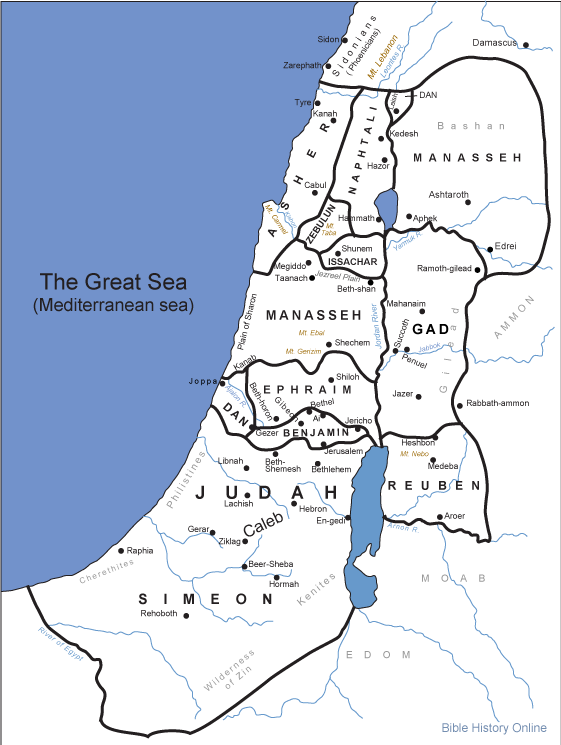
Laws pertaining to deaths that are classified as murders are also dealt with. It is necessary to keep the land clean from innocent blood. What does that mean? The Canaanites and others who occupy this area would not hesitate to spill innocent blood. The Israelites are responsible for cleaning them out and keeping themselves clean. Like that would happen.

Numbers 36 ends the book with an objection to the daughters of Zelophehad inheriting their father’s land. Their problem is that the women may marry men from other clans and the land would go with them. Moses rules that they must marry within the clan to solve this problem.

We have now finished four of the five books of the law. Tomorrow we start the last of these, Deuteronomy. Much may seem like a repetition of the law from the other books we have previously read.

©Copyright 2020 by Charles Kensinger

History revisited for a reminder

Map-Canaan-Twelve-TribesThe history of their travels is recounted in Numbers 33. The Passover is remembered, and each place and event is recorded in sequence. Forty years of history are condensed into forty-seven verses. Many of these places were the sites where Israelites died at the hand of the Almighty. These events are not mentioned here. This is meant to uplift the Hebrews before they enter the promised land. Instructions are given for the taking of their new homeland, the land that was promised to Abram, Isaac, and Jacob. Life is changing and they need to be ready.
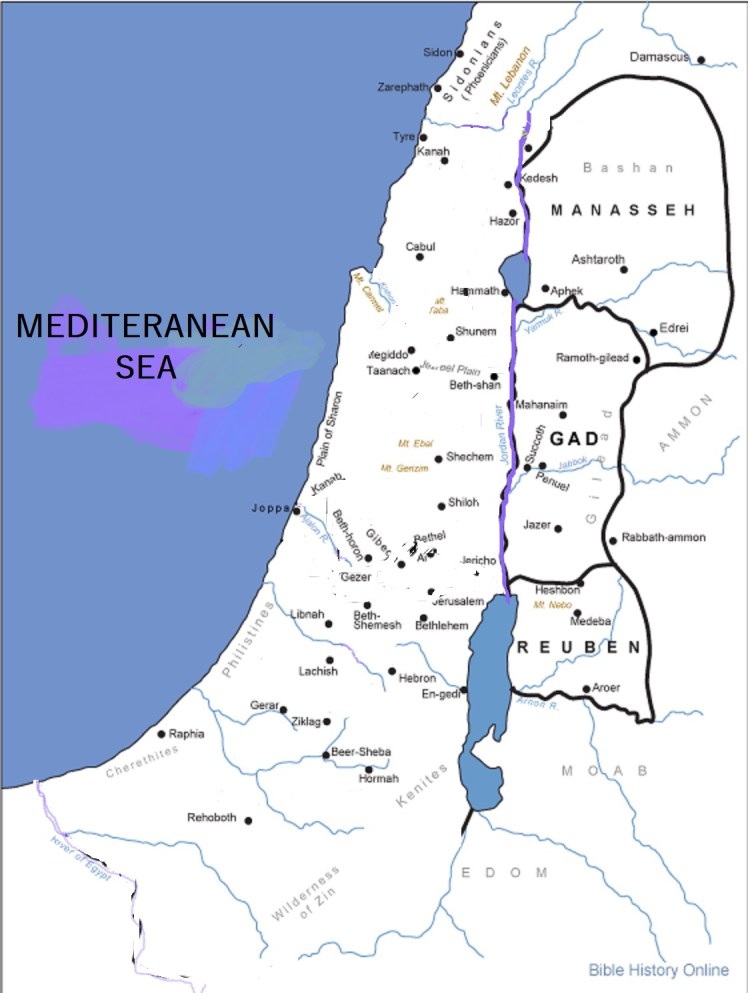
The boundaries are established in Numbers 34. The lines are drawn for the territory that they should ultimately possess. They are to take this land in the next years. Jehovah will be with them and show them when and how to do this. The strength and size of these people that terrorized their parents and grandparents can be overcome by this cooperation. They must remain faithful and dedicated or it will not happen.

©Copyright 2020 by Charles Kensinger

The east bank of the Jordan river

Israel 002Numbers 31 gives Moses a final task before his death. The Israelites are to attack Midian and avenge themselves for the attempt to curse them and the plot of the women that married the Jewish men when this was against their law. The Midianite kings were killed, and Balaam was also executed. The only ones that were to be left alive were the virgin girls. Purification ceremonies had to be observed as well. The spoils were divided among all of them equally.

Slavery is something that is illegal in this country. Keeping the virgin girls and using them as servants or even taking them as wives, seems to go against what God had commanded at other times. God does not always do things in the same manner. This is confusing for us. I understand if it does not make sense to you, because I feel that way, as well.

The first land is granted in Numbers 32.  The Reubenites and Gadites ask for the property that has just been taken.  Their agreement with God and Moses is to leave their families and flocks on this side of the Jordan as they cross with their brothers to claim the rest of Canaan.  The penalty for not following through with this promise will be fatal.

They agree to be in the lead as the land is taken. The agreements are made, and half of Manasseh’s descendants take the land of their own east of the Jordan to become part of this plan.

©Copyright 2020 by Charles Kensinger

Holidays and festivals

Money 001

How important are offerings? Numbers 28 gives instructions for daily, weekly and monthly sacrifices. These will ultimately be ignored once the settlements have been established. This unfaithful group is no different from modern Christians. We often do not listen to the instructions we are given by our Lord. Jesus gave commands to us just as Jehovah has in the Old Testament of the Bible. We are saved from the law, but the commands of Christ should be obeyed in love.

The Passover and the Festival of Weeks or first fruits are elaborated on. All of this is repetition from previous commands. Honoring God by remembering Sabbaths, Passover and other festivals will remind the Israelites of all the things that He has done for them. Christmas, Resurrection Sunday (Easter) and our weekly worship experiences and Bible studies are similar. The Lord’s Supper and Baptism are ordinances that also serve a similar function in the New Testament Church.  Many denominations have their own list of feasts or festivals.

Numbers 29 reminds us of the Festival of Trumpets, the Day of Atonement, and the Festival of Tabernacles. These celebrations are to remind us and the Israelites of God’s grace and favor. The trumpets symbolize the battles that Jehovah wins for the people. The Day of Atonement forecasts the death and resurrection of Christ and our eternal salvation with no further animals being sacrificed. The tabernacles bring to their recollection the forty years in the wilderness due to the unfaithfulness of their ancestors.

Relationships between husbands and wives and fathers and daughters are aided in Numbers 30. Pledges are not something that we are familiar with.  Today a promise is easily forgotten. Even commitments to Christ can be neglected easily.  These verses should be read carefully to see what God wants us to know about making promises to Jehovah and others.

Once again Yahweh is making provisions for women. Wives and daughters are specifically dealt with here. The Lord cares about the females as much as the males. It is tradition and male selfishness that made Jesus teach as much to women as men. Contrary to what some believe, God has always cared about women.

©Copyright 2020 by Charles Kensinger

Dividing the promised land

Map-Canaan-Twelve-Tribes

The reason for the name of the book of Numbers comes up again in chapter twenty-six.  Jehovah orders a census to determine the fighting strength of the body.  It is not for His benefit.  He already knows.  Every time a baby is born, or someone dies, or a foreigner joins the entourage, it does not escape His notice.

It was necessary for them to know how to divide the land when they entered it.  The divisions were to be based on the number of males over twenty years of age.  Caleb and Jacob would be the only survivors over sixty years old.  Remember, they will have been wandering for forty long years when they march on Jericho.

Women’s rights begin with Numbers 27 when Zelophehad’s five daughters approached Moses about an inheritance for their father. Should his family be left out because he had no male offspring? God made a law that daughters would inherit from their father when no sons were alive to accept the heritage.

Moses is about to be called home by the Lord. A new leader must be appointed.  Joshua is the man Yahweh says should be commissioned to this role. The entire camp gathers as his authority is given from God through Moses and the priest, Eleazar.

©Copyright 2020 by Charles Kensinger