
Dysfunctional family

Genesis 32 tells the story of Jacob’s preparation to meet his brother for the first time in years. He separates his wives and children into two groups. His preference for Rachel and Joseph is obvious.

After sending everyone and everything over the river, he spends the night alone in a battle with God. Many of us struggle with our faith. Direct combat with Jehovah is unusual. Jacob’s name is changed to Israel and he is injured in the turmoil. His fear is of his brother and how he will be greeted.

The story of Jacob and Esau’s reunion is told in the thirty-third chapter of Genesis. Esau is happy to see his brother.  Jacob does everything he can to regain his older brother’s trust. It seems this is not needed.

Israel (Jacob) is concerned that Esau is as sneaky as he has been. He does not want the help of his brother or his men. He even lies and says he will follow to Seir but turns to Sukkoth. He still has not changed his devious ways.

It is very unusual when a daughter is listed in the genealogies. In chapter 34 we discover why Dinah was mentioned. She is raped and Jacob’s sons continue the heritage of their father.

They agree to give her as a wife to her rapist, but only if all the men of the city are circumcised. Circumcision is part of the Israelite covenant with Jehovah. It started with Abraham and Isaac. It seems like a reasonable request.

Three days later the true reason is revealed when all the men are killed and all their possessions, women and children are seized. This seemed to be the plan that the Hivites had in mind for Jacob’s family. Were they wrong to exact such severe punishment on the entire city because of the action of one man?

©Copyright 2020 by Charles Kensinger

When a woman can’t get pregnant

A question to ask about Genesis 30 is, “Does God determine whether a couple can or cannot have a child?” If He does, what criteria does He use?  I know it can’t be whether you will be a good parent or have a healthy marriage.

Twelve children are born into Jacob’s family through the four women.  Leah stays in the lead by number, but not by love.  One daughter is mentioned, and the rest are sons.  Only Joseph is by Rachel.  This will play a factor later.

The last of our selection tells how Jacob deceived his father-in-law and increased his flocks while decreasing Laban’s.  Human nature is very active in the soon to be the Hebrew nation.

If Jacob is to be the son that carries the promise of possessing the land Abraham and Isaac were promised Genesis 31 tells us that God instructs him to return.  The animosity between Laban and his men and his son-in-law has grown to a dangerous pitch.  In justifying the move to his wives God’s chosen one does not explain the reason why spotted and striped animals outnumbered light colors.

We are not told why Rachel stole her Father’s idols.  They may have been valuable, or it might be spite or sentimental value.  We don’t know.  Jacob makes a dangerous statement about killing the thief if there is one.  Rachel has learned from her Father and Husband and moves the stolen goods while the search is on.

When nothing is found a truce is arranged and the two go their own ways.  Laban refers not only to Jehovah as the God of Abraham but also of Naho, Abraham’s father who was the first to start for Canaan.  He is the common ancestor of the two clans.

©Copyright 2020 by Charles Kensinger

The trickster at work

The story of Jacob lying to his Father and his mother starting the whole situation is told in Genesis 27.  She is as deceptive as her youngest son.  The deceit pits the two sons against each other and results in her favorite child having to leave home.

Isaac must have been very gullible, or he would have trusted his ears and not the word of a liar.  He certainly would never have believed his wife and son would steal the blessing of Esau.  Esau is the ancestor of the Edomites who also becomes an enemy of Jacob’s family.  How you treat someone today can affect history.

Genesis 28 begins with Isaac blessing Jacob and sending him back to their family to find a proper wife.  Esau hears of this and realizes how he has displeased his parents.  He takes an Ishmaelite woman as a third wife.

Jacob dreams his first night on the road and sees angels traveling to and from Heaven.  God renews the promise that he made to Abraham and Isaac to make them a great people group.  Jacob named it Bethel and used the stone that was his pillow as a monument to the vision he had seen. He then makes what seems to be a bad statement.  If God will do all of these things that have been promised, he will make God his god.

This is what many of us do.  God must prove Himself and then we will worship Him.  What God wants is our obedient worship.  God will bless our faithfulness.  Who do we think we are to expect Jehovah to bless us before we follow Him?  And who am I to stop following Him, when he doesn’t do what I think He should?  Which one is really the ruler of the universe?

The joke is about to be on the jokester in Genesis 29, our reading for today.  Two interesting things are the procedure for watering the sheep at the well and the reason the stone was over the well.  What do you think?

Jacob met Rachel and waters her sheep ahead of the others.  This may not have made him one of their favorite people.  Rachel shows her gratitude and takes him to meet her father Laban.  He is warmly greeted and then he meets his match.

Rachel is beautiful and Jacob agrees to work seven years for her hand in marriage.  After the wedding ceremony at the end of the seven years, Jacob wakes up to discover he is married to the older, ugly sister.  Laban agrees to give him Rachel also after the marriage week in return for another seven years of work.  The agreement made Jacob gets two wives in two weeks.  The trickery is just beginning.

©Copyright 2020 by Charles Kensinger

Abraham’s other family

Where Was MidianWe read about the second wife and other children that Abraham had after Sarah died in Genesis 25. One of these sons is Midian. Remember this name. He is the father of the Midianites that gives the Israelites problems when they return to Palestine. Isaac was still the favored son and the others received gifts from their living father.  However, they received no inheritance.  When Abraham died, he was buried with Sarah in the family tomb.

We are also introduced to Ishmael’s twelve sons.  God’s promise is already starting.  Isaac and Rebekah have twins.  Esau is the older and is named hairy because he was from birth.  Jacob means deceiver and we will find this is also true.  He was not being deceitful when he had his brother sell him his birthright.  This was easily agreed to by both because the older brother did not understand what it meant to be a descendant of Abraham.

Genesis 26 makes me want to say, “Here we go again.”  Isaac repeats what his father did by deceiving people about who Rebekah was.  Despite it The Lord blessed them with great wealth.  Isaac shows wisdom like his father by leaving when problems came and signing a treaty with the Philistines.  This is interesting when we find the Philistines become enemies later when the Israelites return from Egypt.

The chapter ends with Esau marrying two Hittite women.  Neither Isaac nor Rebekah are pleased by this development.  What do you think?

©Copyright 2020 by Charles Kensinger

Does God still require sacrifice?

Why would God ask Abraham to sacrifice his son Isaac?  In Genesis 22 that is just what happens.  Read it and share your thoughts with us.  God gives laws later that instruct His people not to sacrifice their children or other humans.  This chapter seems directly contradictory.   Let’s look at the story through the eyes of the boy.

Isaac had seen sacrifices before and asks his father why they have the wood and the fire, but no animal.  He must have been terrified as he was tied and placed on the wood.  His father may have approached him from behind with the knife.  This could have prevented some of the terror of this situation.

Abraham told his son that God would provide the sacrifice and that is what He did.  Those who do not believe the Bible will argue that this never happened or that Isaac’s father came to his senses before it was too late.  The presence of the ram was a coincidence.  God never intended Abraham to harm his son, Isaac.  This was only a test.  Any comments?

In Genesis 23 we again read another story of the integrity of Abraham.  Even with the death of his wife, Sarah, he shows honor to those he lives among.  As a nomad, they did not own any property.  The Hittites were willing to provide a tomb for Abraham at no cost.  This was not what was needed.

If the land was to ultimately be the Patriarch’s inheritance to his offspring, why would he need to purchase land of a burial site?  As we continue to read, we will see that many of the leaders were taken to this cave and buried with their ancestors, before all the land belonged to them.

Genesis 24 tells about the marriage of Rebekah and Isaac.  Abraham’s servant is sent to the land that his master’s family calls home.  The prayers that are sent to God are significant.  They are like requests we may make to God.

If this happens, let it be your will.  Sometimes we think of this as a deal we make with our heavenly Father.  God doesn’t make deals.  He does answer prayers.  Even simple ones.

Today we marry the one that we love.  In Abraham’s day, Isaac was expected to love the wife that his father gave him.  He did.  This indicates to us that love is not an emotion but is indeed a choice.

©Copyright 2020 by Charles Kensinger

Lot and the destruction of the cities

Chapter 19 in Genesis has so many disturbing aspects to it that I must restrain myself or we will be here all day.

Only two of the three men who visited Abraham arrive at Sodom.  Scripture calls them messengers.  They want to spend the night outside, but Lot won’t allow it.  He knows what will happen.  All the men in the city demand that Lot send them out.  The Bible is clear as to what they want.  That is why sodomy is the name for forced homosexual activity.

The Ammonites and the Moabites are introduced as the children of Lot by his two daughters.  This chapter has incest and homosexuality.  Were these “the good old days?”

Here we go, again.  Many things about chapter 20 of Genesis seem to be Deja Vu.  Abimelech takes Sarah just as was done in chapter 12.  The deception is planned to save Abraham’s life.  I call this a deception and not a lie because Sarah was his half-sister.  They had the same father, but not the same mother.

Abraham’s explanation to the king of Gerar is that he feared for his life.  God calls the Patriarch a prophet and tells Abimelech that despite Abraham, Jehovah will protect him and his family.  Once again, the errors of the humans are corrected by the Almighty.  This still happens today.  Often, we don’t give Him the credit when He rescues us.

Today’s reading from Genesis 21 announces the birth of Isaac to Sarah and Abraham.  This time of joy is soon disturbed by another problem.   Ishmael is making fun of the baby and Sarah demands that he and his mother leave.

God intervenes after they are forced out and shares that Ishmael will be the ancestor of his own nation.  Many of the Arab countries that are at war with Israel today trace their heritage and hatred of the Jews to Ishmael.

The chapter ends with the formation of a treaty with Abimelech the Philistine.  This started as a battle over a well which was always at a premium in this desert area.  Once again good judgment is shown by the father of Isaac.

©Copyright 2020 by Charles Kensinger

Not Sarai’s son

Baby 001Genesis 16 tells Sarai’s idea of how they could have a child.  It was in common use in their culture.  As our times and current popular opinions often lead us in directions God would not approve Abram and Sarai made a similar mistake.  A child by another woman was not in Jehovah’s perfect will.
This hiccup did not surprise Him.  His promise of the number of people groups that would come from the Patriarch is increased even more through Ishmael.  While this was not the original plan it did not destroy God’s goal.  Often, we delay God, but can never derail Him.

In Genesis seventeen we are introduced to circumcision as a symbol of nationality.   Even today Hebrew males have their foreskin removed eight days after their birth.  The ceremony is called a bris.  It is equivalent to the Baptism of babies in certain Christian denominations.  Without it, your son will not be part of the inheritance of Abraham.

God also changes Abram’s name from Exalted Father to Father of Many.  This is also the chapter where Sarah’s name is changed, and God includes her in the biological lineage of the nations and kings to come.

The name of the child to carry the covenant is interesting. Isaac means He Laughs. Every time Abraham and Sarah called their son, they would be reminded of the fact they thought this child being born was laughable.

We’ve arrived in chapter 18 of the first book in the Old Testament. Abraham sees three men coming towards his tent. He implores them to stop and eat with him. They stayed for several hours. Long enough to butcher and cook a calf. This is a much longer process than thawing steak in the microwave.

Some believe this was an early incarnation of Jesus with two angels. Others view the three as representing the triune Godhead. The Lord announces that the child will be born within a year. This time, it is Sarah’s turn to laugh at the idea.

The purpose of the visit is to warn Lot and Abraham that Sodom and Gomorrah will be destroyed. Abraham convinces God not to follow through if only ten righteous people can be found. This story continues tomorrow.

Abram’s travel plans

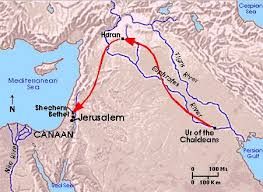
Map of the Middle East 002

Genesis chapter 12 is what we will read today. We are continuing to follow the chronological order. God’s instruction to Abram was to go to a land that He would show him.  Anyone want to make travel plans this way?  Promises are made to him.  Blessings and cursing would be dependent on him.

Being called by God does not guarantee that all our decisions will be good.  The story of Abram telling Sarai to lie about being his wife does not seem to indicate his honesty and desire to protect his wife.   God protected Sarai when her husband would not.  God often protects us from ourselves.  Currently, Abram was not a man of faith in Jehovah.

The story of nephew Lot begins here in Genesis chapter thirteen.  Lot and Abram both had large flocks and herds.  As nomads, they constantly moved around to find new grazing grounds.  Their shepherds and herdsmen were fighting over the best grass.

Previous incidents did not demonstrate any Godly wisdom from the Patriarch.  However, this time he approaches the situation with much discernment.  He allows Lot to choose which direction to go.  There is no bad ground here.  Only good, better or best.  To the human mind, Abram goes to the wrong area.  It is not the best.  We’ll talk about this when we read other chapters.

God promised to fill all the land around Abram with his offspring.  This included where Lot had gone.  Jehovah always remembers His promises.

Our story starts with a war that involved Abram’s nephew Lot in Chapter fourteen of Genesis.  His side is defeated, and his uncle comes to their aid.  The smaller force is successful in recovering property and freeing Lot and others including women.

Abram gives the priest of Salem a tithe of the proceeds from the rescue.  Melchizedek is honored and blesses Abram.  Apparently, he is a worshiper of Jehovah.  The Patriarch also refuses to accept profit from the King of Sodom for the rescue.  This is one of Lot’s first problems with his choice of place to reside.

Melchizedek has a short scene here. In Paul’s writings, we read that Christ is a priest on the order of this man. He predates the Aaronic priesthood. He is different from what we normally think of as a priest of Yahweh.

Jehovah makes an everlasting covenant or agreement with Abram today in Genesis chapter fifteen. The method of securing a legal agreement was by splitting animals and laying them out in a manner where you could pass between the two halves. The animals were laid out and a firepot representing God passes through. Abram believes and it was counted as faith. He still was not perfect but did believe that this promise would be kept. That is all God wants us to do. Believe Him one step at a time.

©Copyright 2020 by Charles Kensinger

I’m sorry Yahweh

Jehovah tells Job to answer Him in chapter forty. Job replies by apologizing. He decides that he has said enough. “Would you discredit my justice?” is another question that Jehovah asks of us. Sometimes we do want to argue that He is not always just, but that is because we think He is being unfair to us or someone we care about. Like Job, God may not be the one that is responsible for the actions that we blame on Him.

What is a Behemoth or a Leviathan? They are described here. They do not sound like anything I have seen in a zoo, but they resemble the reconstructed dinosaurs that are in some museums. This is a reason why this book is dated just after the flood. The creatures are now extinct but did exist at one time. The words about Leviathan take up all of chapter forty-one. Look at these two descriptions and decide if you know what they could be.

Job acknowledges again in chapter forty-two that God can do all things and that he did not know what he was talking about when he questioned His motives and actions. This story has a happy ending when Job’s friends are put in their place and Job prays for them. Job’s fortune is restored, and he and his wife are blessed with more children, seven sons, and three daughters. He lived another one hundred and forty years. His life was not cut short.

What Jehovah has to say

I Am God

We and Job have been waiting for this and now, in chapter thirty-eight, we wish we were not included in what God has to say. Job did speak without knowledge. He accused Jehovah of punishing him unfairly. We know that it was Satan that inflicted this pain on him. All the questions that He asks are valid. We do not know any of these answers. Sarcasm can be from Yahweh as He shows us in verse twenty-one. In verses thirty-one through thirty-three He speaks of stars and constellations. What are the laws of the heavens that is spoken of here? Many of their movements are understood better now than in previous times.

Wild animals that are mentioned in chapter thirty-nine are now monitored by conservation groups. This did not happen in Job’s time. Many wild animals are captured and tamed in the modern world. Men can learn some of these facts about the wild animals, but most of us are ignorant of them. The wisdom of the Lord is beyond us. Job has been put in his place.