
Rehoboam and the split of Israel

Jeroboam had been a thorn in the side of Solomon and returns in 1 Kings chapter twelve. Rehoboam goes to Shechem to become his father’s successor. Jeroboam returns from Egypt and is asked to join them at Shechem. Israel asks to have the tax and labor burden reduced. Remember the King’s comments in Ecclesiastes about everything he had built and accomplished. The people think they have completed these projects.

After three days, Rehoboam answers Jeroboam and his supporters. The younger advisers disagreed with Solomon’s men. The new King follows the youthful answer. Often older heads are more conservative. In this situation that could have prevented a split between Israel and Judah.

Shechem is the seat of Jeroboam’s new government. To prevent the people from returning to Jerusalem to worship Jehovah, he had two golden calves made and established worship of idols. Nothing he did was to worship the one true Creator God.

1 Kings 13 tells of Jeroboam and a man of God who came from Judah and announced Jehovah’s displeasure with the new altar that has been built to worship the golden calves. When the Israelite King tries to take him, the altar is split in two and the hand of Jeroboam shrivels. The King repents, and his hand is restored.

Yahweh has instructed His man not to accept anything from the Israelites and to return to Judah by a different route. An older prophet intercepts him and lies to him. We all need to listen to God and sometimes ignore others if they try to contradict what God has told us. This man of God’s disobedience is punished by death. The old prophet has no remorse but does bury him.

Jeroboam does not correct his mistake, and this is the reason his line is removed from the rule in Israel. His sin is followed by all the other Kings of the Northern Kingdom. It will ultimately result in the fall of the country.

Has God ever told you something that was going to happen? In 1 Kings 14 Jeroboam sends his wife to the prophet Abijah to ask for his son’s healing. The Prophet knows that she is coming because Jehovah told him. He also has a message for the King of Israel. He is the last of his line. Israel itself will fall because of the idolatry the Kings allow. Jeroboam is the first of many evil rulers. The next monarch is Nadab, the son of Jeroboam.

Rehoboam was not much better in Judah. Shishak, who was the Egyptian Pharaoh attacked them. He took the gold items from the Temple that Solomon had dedicated. Abijah took over for his father when Rehoboam died.

©Copyright 2020 by Charles Kensinger

Who is Agur the psalmist?

Who is Agur in Proverbs 30? I don’t know. If you do, comment below. Despite being down on himself, as many of us are from time to time, he knows the Lord is in control. He asks for only his daily bread. That is what we should desire as well. He gives us the reasons.

Those who are pure in their own eyes, see no reason to improve. This reminds me of the Pharisees in Jesus’ day. We misunderstand the same things he does. Especially a man with a woman. No matter how many years we have been married, we still don’t fully understand them.

In Proverbs 31 we have another writer that we know little about. There are no Israelite kings named Lemuel. These are instructions from his mother. She warns him against women, alcohol, and encouraging him to speak up for the poor and needy.

These last twenty-two verses are some of the most often read in Proverbs. They are especially used on Mother’s Day. Women are encouraged to follow this lady. Her husband is confident in her because she is good, wise in business, hard-working, and respected in the community. Even though nothing is said about her looks, she is beautiful on the inside.

©Copyright 2020 by Charles Kensinger
Solomon’s reign ends


The relationship between King Solomon and the Queen of Sheba is told in 1 Kings 10. She comes all the way from her country, which is now known as Ethiopia. She arrived in Jerusalem with a large convoy and much to trade. Solomon gave her a personal interview and answered all her questions. She concluded that what she had heard in her own country was only half of what was told about the Israeli King’s true wisdom.

The wealth and magnificence of Jerusalem and Israel during this time was not to be compared with any other nation at that time. This was in response to what Jehovah had promised Solomon when he had requested wisdom instead of wealth or fame.

We also have the story of the Queen and Solomon in 2 Chronicles 9. The stories are mostly the same. The difference from First Kings and Second Chronicles is that Chronicles story ends with the death of Solomon. The books listed that tell of the other exploits of the third King of Israel are probably combined in all or part for the material in First Kings.

Remember when I said we would read about the reason why Solomon did not receive the same promise that his father, David, did? 1 Kings 11 tells us why Israel splits from Judah. We begin with all the women that became wives of the King. Seven hundred wives and three hundred concubines. Imagine having sex with one thousand women.

This alone is a violation of the law of Jehovah. Most Hebrew men of that day would marry as many women as they could afford. The usual excuse is to have children to keep their flocks and maintain their property. Trading daughters to be wives of other rulers is to prevent wars.

The main sin listed here is the accommodation of the religions and gods of all these women. A place to worship Egypt’s deities and all the gods of the nations around them are also created by Israel’s King.

Before the death of Solomon is told, we read about the enemies of Israel including Jeroboam who will lead the ten northern tribes away from Rehoboam, the son of Solomon. This split is the end of the dynasty of King Solomon.

©Copyright 2020 by Charles Kensinger

No one does not sin

Wisdom is the focus in Ecclesiastes 7. Many of the verses are repetitions from Proverbs. Not all of them are. “Death is better than your day of birth.” It is better to mourn than to feast. He advocates frustration over laughter.

Jehovah is the main thought after verse thirteen. Good and bad happens to everyone. An error is made by attributing evil to God. He may allow events that we view as less than ideal, however the sin in our world is responsible for the evil actions of others. Satan is also working freely on people.
If you respect Yahweh, you will avoid the extremes. Verse twenty has a New Testament concept. No one on Earth never sins. Solomon’s chauvinism is seen when he says that there is one righteous man among a thousand, but he has not known one good woman. If I had to please a thousand women, I would feel that same way.

Does it surprise you that in Ecclesiastes 8 the King says we should obey the King? One thing he says is that the sentence for a crime should be carried out quickly. He has seen one thing that perplexes him. The righteous being treated like the wicked should be. This makes him not understand what happens.

We must agree. Whose fault is it? Ours. If humans do not obey the Lord and treat others with love, how can we expect things to get better. Isn’t it hypocritical of the King to brag about everything he did? If he had not been so tied up in his own goals, he could have helped others’ lives not be so meaningless.

Everyone has the same future according to Ecclesiastes 9. We will all die and after that there is nothing else. Solomon has forgotten that Jehovah promised His people life with Him forever. He also warns us that we never know when our end will come. Solomon tells us to enjoy life with the wife that we love. With all the wives that he had, I wonder how many he loved.

Have you wondered why politicians are referred to as right and left? Ecclesiastes 10 may have the answer in verse two. Calmness is also praised. Pits, walls, stones, logs, and axes are also discussed. When he says, “fools multiply words” we need to make note and watch our speech.

Prejudice rears its ugly head when Solomon once again criticizes Kings that are not of royal lineage. Has be forgotten his own father had been a Shepard? “Money is the answer for everything” seems also to be an error on the part of the King.

Diversifying investments is encouraged in Ecclesiastes 11. Some of these wise sayings seem to be common sense. One of these is understanding what Jehovah does. Enjoy all your days, but don’t forget the bad ones, also seems to be common sense. God’s judgment will come.

Remembering Yahweh in our early years is a way to prevent a bad attitude in later years is in Ecclesiastes 12. Solomon has apparently reached this point because he declares everything as meaningless. The editor has added praise for the King’s wisdom. He and I have differing opinions.

©Copyright 2020 by Charles Kensinger

Justice for all

Be careful of bragging about things that have not happened yet is in Proverbs 27. Praise should come from others not ourselves. This praise helps make us better.

Friendship is to be cherished especially in those who are close. We are to help our friends improve.  

When Jehovah destroyed Israel and Judah, it was due to inequality and lack of justice as taught in Proverbs 28. Prayer is worthless to those who ignore the commandments of God.

Leaders should not be working for their advantage. Generosity and wisdom from the head of the country is needed. 

Too much criticism can cause people to be broken in spirit in Proverbs 29. Other sayings in this chapter are that men who complain a lot will trap all those around, but the wise can prevent anger. Anyone who believes lies will have a lot of liars around them. Honest people and dishonest one will always be in opposition. This means that when they seemingly are honest, but defend the dishonest, maybe they aren’t as reliable as you think they are.

A judge that treats the poor fairly will be in authority for a long time. True justice comes from the Lord. Discipline of a child benefits both the child and the parents. Pampering of a child leads to insolence.

©Copyright 2020 by Charles Kensinger

There is nothing new under the sun?

The title of our next book is Ecclesiastes. Chapter 1 calls the writer the teacher or preacher. He begins by declaring that everything is useless. The world is nothing but repetitious. Anything we do today must be done again tomorrow.

Verse nine says that there is nothing new on this planet. If this is incorrect, then the Bible does contain errors. We know that is not possible. How can this statement be true? Remember Genesis six and the flood in the time of Noah. An objection to the validity of that story is the likelihood of the ancients being able to build a structure like the Ark. Thousands of years passed before the flood and people lived to be hundreds of years old. It would make sense that their technology would exceed even ours. Especially when we look at all the examples of monuments from the prehistoric world that are inexplicable with what we consider caveman knowledge.

We just finished reading Proverbs. This is the major book of wisdom written by King Solomon. He declares that even wisdom is vanity. A man who began his journey with such promise has now become discouraged and disillusioned. Remember that by this time he had wandered from Jehovah and built temples for his wives to other deities. When we walk away from the Lord we often lose confidence in anything.

When you are King, you have endless options for distractions as in Ecclesiastes 2. If we are depressed, we usually binge eat. You may clean, watch TV, read or something else. Solomon tried pleasure, work, and many other ideas. How do your distractions help you overcome a feeling of worthlessness?

I have discovered that studying God’s word works for me. Have you tried that? Does reading along with us give you a feeling of purpose? This may benefit me because I must read along with you.

Solomon refused himself nothing. This may be the problem. Most of us have goals that give us something to look forward to. My writing and sharing it with you gives me that hope. Look for something that you enjoy and challenges you. Most of all, ask God what His plan is for you. Then follow Him, unlike this King.

There is a time for everything as given in Ecclesiastes 3. Let’s look at some of these that you may not have noticed previously. A time to mourn and a time to dance. Many of us Baptists want that one removed. We prefer to mourn and do not think we should dance. Be like Solomon’s father, David, dance when Jehovah needs to be praised.

A time to search and a time to give up. When do you quit? It depends on what you are searching for. As a child, we stop looking for shoes or other things we need for school, if we don’t want to go. As adults we accept defeat, when we feel defeated and want to give up. Do not stop without talking to God first.

Hoarders need to listen to the time to keep and a time to throw away. I need to remember there is a time to be silent and a time to speak. Some of my quieter friends need to talk more often. I don’t have that problem.

“Everything is beautiful in its own time.” Now you know where Ray Stevens found that line. He just changed one word. You have eternity inside of you. Yahweh put it there. The King’s negative mood is the result of his rejection of the Lord. He does admit that if God does something, it will last. What we do on our own, will not. He also tells us that we are no better than animals. Once again, his personal feelings are expressed. We know differently from what Jehovah tells us.

The dead are better off than the living and in Ecclesiastes 4 the unborn have it best of all. Talk about being depressed. All achievement springs envy. Three strikes and he’s out.

Two are better than one starts out positive but turns negative when he says to pity those who are alone. He comes back positive again with “A cord of three strands is not easily broken.” This is often used regarding marriage. The third strand is Jehovah. 

Sacrifice was often viewed by the Hebrews as the correct form of worship. In Ecclesiastes 5 tells us that listening to what Yahweh must tell us is better than sacrifice. Promises to God should be taken seriously. Today we often make deals with Him in times of trouble. Be careful what you tell Him. He could take what you promise despite yourself.

Money is a definite problem for all of us. If we do not have enough, we worry. Good finances also cause us to be distressed. The wealthy usually are concerned with the possibility of losing their high estate. Our faith needs to be in Jehovah and not in our ability to earn a living.

We continue thoughts on prosperity in Ecclesiastes 6. The King believes that it is impossible to enjoy one’s wealth and challenging work. He declares it all useless. We can have peace whether we are poor or rich if we rely on the Lord. The vanity of the King is the result of disobedience. Guilt over this has caused his anguish. 

©Copyright 2020 by Charles Kensinger

Proverbs of the Hezekiah era

Proverbs 25 may sound familiar. These are from Solomon but compiled during the time of Hezekiah. Exalting ourselves, false testimony, and boasting are condemned. How to treat an enemy is mentioned. Quarrelsome wives are criticized.

Wise judgment is like gold and silver. Patience, temperance, and self-control are praised.

Contradictions in the Bible are a complaint many have. Proverbs 26:3-6 is said to contain these. If you act foolishly in front of a fool, you are sinking to his level. You need to present him with the facts. The foolish can become wise, but not until they recognize their own foolishness.

The lazy is another group that is dealt with here. They seem to always have an excuse for not working. They are too lazy to even feed themselves. 

©Copyright 2020 by Charles Kensinger

Construction continues

The restating of these activities to dedicate the Temple of Solomon continues in 1 Kings 9. The building of God’s house and the palace took twenty years. Forced labor by foreigners was used to create these structures. Gezer was rebuilt after Pharaoh burned it when he took the area and gave it to his daughter for a wedding gift.

The kings of Tyre and Israel continued their cooperation despite a minor disagreement about methods and quality of payment for services rendered. This included building a fleet of ships for trading.

The building of the cities, walls and gates is also covered in 2 Chronicles 8. This version tells that the Israelites were not made slaves by their King. This was reserved for the Canaanites that still resided in the land. In this account the ships were provided by Hiram.

©Copyright 2020 by Charles Kensinger

Trust in the Lord

Do you praise the Lord with your hands lifted high? The Psalmist who wrote the 134th Psalm did. Jehovah will bless you if you praise Him in any manner that you wish. Praise is voluntary and so is the manner of praise.

Our trust should be in God not in other people according to Psalms 146. All humanity returns to the earth we are made from. Only Jehovah is eternal. He is the creator of the universe. His promises endure when others fail you. Praise the Lord.

Praising Yahweh is the focus of Psalm 147. We praise Him for what He has done and what He is doing. Praise does not always involve music, but in this case it does. Peace and provision are two things we can praise Him for. Our ability to have the Lord’s law is by God through the Israelites.

Who is going to praise the Lord in Psalm 148? The angels, heavenly hosts, the sun, moon, stars, the heavens, the waters above the skies, creatures in the seas, animals both wild and domesticated, natural phenomenon, and every human regardless of their age or place in life are commanded to praise our God the creator of everything in the universe. We are reminded that He has a chosen people that should follow His commands. In today’s world, that is Christians.

Singing a new song in Psalm 149 we will praise Yahweh. We should rejoice in the one who made all of us and everything. Praise can involve dancing and music. It also comes from our mouths and hands. Praise will allow Him to solve our problems and rescue us. Praise the Lord. 

Concluding our reading of the Psalms with 150, we praise the Lord in His sanctuary in the heavens, for His power and greatness with music and dancing. Let everything that has breath praise the Lord.

©Copyright 2020 by Charles Kensinger

Dedication of the Temple

June 12, 2020

We will now begin to look at two different versions of the construction of Solomon’s Temple in 1 Kings 6. Four hundred and eighty years after the Exodus the work begins. We are given a detailed description of this structure.

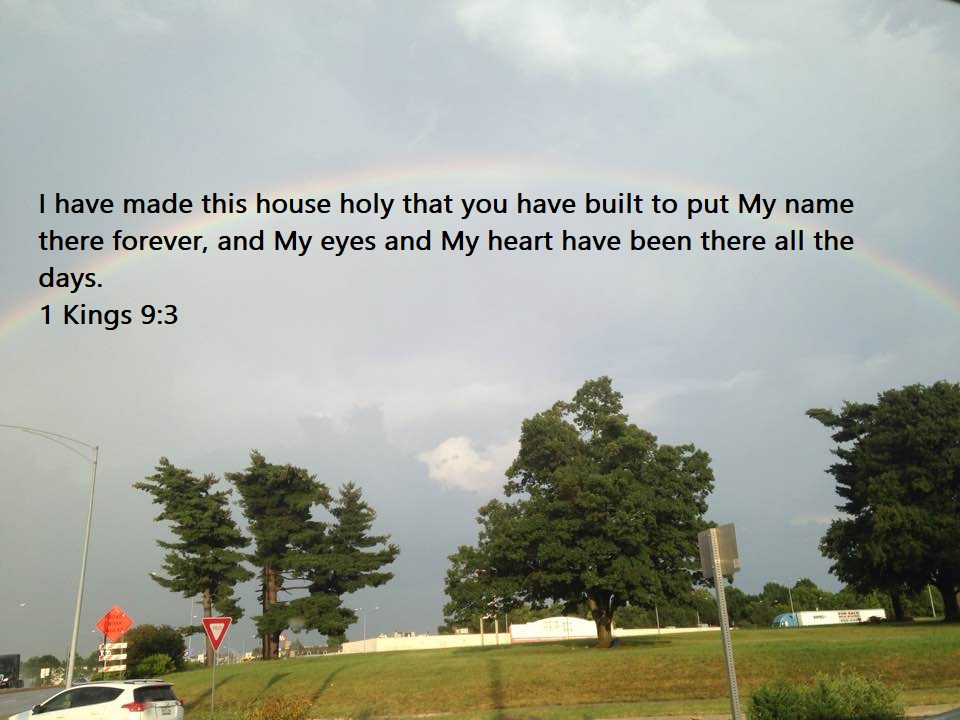
Once again, however, there is a message from Jehovah that contains an “If” clause. They must obey everything He has commanded if they wanted Him to continue to abide there. No matter how beautiful the building, for God to stay, we must follow his instructions for our lives. Even if we take seven years or more for the construction.

Fire comes down from Yahweh in 2 Chronicles 7. After the Lord consumes the first sacrifice that is offered, many others are presented. This was just the start of the two-week party.

Solomon hears from Jehovah a second time. The blessings and the curses that were given to Moses are given to the King. He is told to follow God’s laws and his throne will be established. It ended at his death. We will look at the transgressions that caused this later.

We thank Jehovah in Psalm 136 for His goodness, creation, mercy, and miracles. His power and glory are great. His love endues forever, and we should thank Him for that.

©Copyright 2020 by Charles Kensinger