
The cities of refuge

Numbers 36 13Preparations must be made for the move into Canaan. Numbers 35 tells of the cities that are to be established for the Levites. Six of these are to be cities of refuge. These cities are the ones that a person may go to in order to save themselves if they have accidentally killed another person. The law allows a family member to avenge that death, but not in a city of refuge. Once there the guilty person is secure from retribution. They must stay in that city to be safe.

Laws pertaining to deaths that are classified as murders are also dealt with. It is necessary to keep the land clean from innocent blood. What does that mean? The Canaanites and others who occupy this area would not hesitate to spill innocent blood. The Israelites are responsible for cleaning them out and keeping themselves clean. Like that would happen.

Numbers 36 ends the book with an objection to the daughters of Zelophehad inheriting their father’s land. Their problem is that the women may marry men from other clans and the land would go with them. Moses rules that they must marry within the clan to solve this problem.

We have now finished four of the five books of the law. Tomorrow we start the last of these, Deuteronomy. Much may seem like a repetition of the law from the other books we have previously read.

©Copyright 2020 by Charles Kensinger
History revisited for a reminder

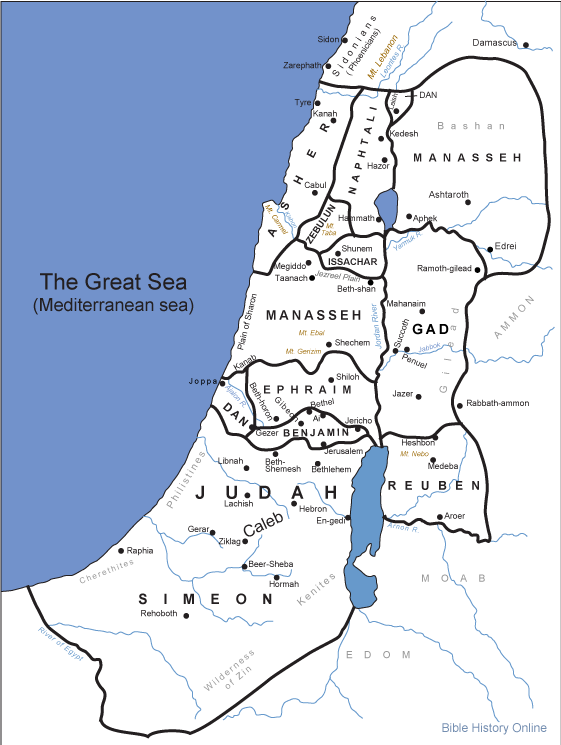
Map-Canaan-Twelve-TribesThe history of their travels is recounted in Numbers 33. The Passover is remembered, and each place and event is recorded in sequence. Forty years of history are condensed into forty-seven verses. Many of these places were the sites where Israelites died at the hand of the Almighty. These events are not mentioned here. This is meant to uplift the Hebrews before they enter the promised land. Instructions are given for the taking of their new homeland, the land that was promised to Abram, Isaac, and Jacob. Life is changing and they need to be ready.
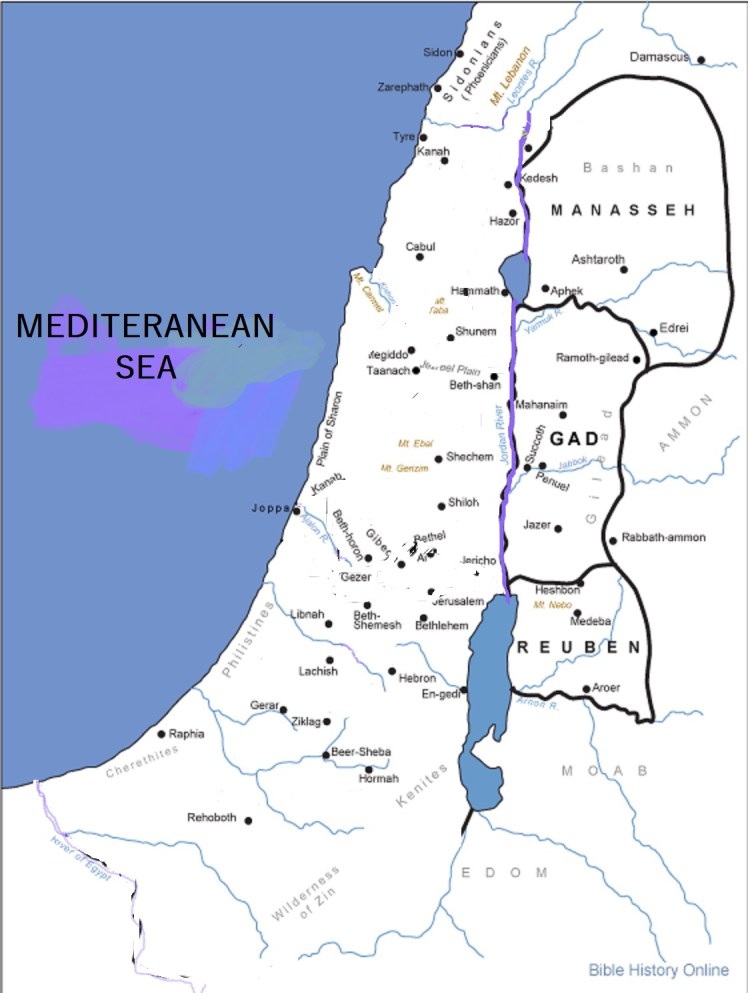
The boundaries are established in Numbers 34. The lines are drawn for the territory that they should ultimately possess. They are to take this land in the next years. Jehovah will be with them and show them when and how to do this. The strength and size of these people that terrorized their parents and grandparents can be overcome by this cooperation. They must remain faithful and dedicated or it will not happen.

©Copyright 2020 by Charles Kensinger

The east bank of the Jordan river

Israel 002Numbers 31 gives Moses a final task before his death. The Israelites are to attack Midian and avenge themselves for the attempt to curse them and the plot of the women that married the Jewish men when this was against their law. The Midianite kings were killed, and Balaam was also executed. The only ones that were to be left alive were the virgin girls. Purification ceremonies had to be observed as well. The spoils were divided among all of them equally.
Slavery is something that is illegal in this country. Keeping the virgin girls and using them as servants or even taking them as wives, seems to go against what God had commanded at other times. God does not always do things in the same manner. This is confusing for us. I understand if it does not make sense to you, because I feel that way, as well.

The first land is granted in Numbers 32.  The Reubenites and Gadites ask for the property that has just been taken.  Their agreement with God and Moses is to leave their families and flocks on this side of the Jordan as they cross with their brothers to claim the rest of Canaan.  The penalty for not following through with this promise will be fatal.

They agree to be in the lead as the land is taken. The agreements are made, and half of Manasseh’s descendants take the land of their own east of the Jordan to become part of this plan.

©Copyright 2020 by Charles Kensinger

Holidays and festivals

Money 001

How important are offerings? Numbers 28 gives instructions for daily, weekly and monthly sacrifices. These will ultimately be ignored once the settlements have been established. This unfaithful group is no different from modern Christians. We often do not listen to the instructions we are given by our Lord. Jesus gave commands to us just as Jehovah has in the Old Testament of the Bible. We are saved from the law, but the commands of Christ should be obeyed in love.

The Passover and the Festival of Weeks or first fruits are elaborated on. All of this is repetition from previous commands. Honoring God by remembering Sabbaths, Passover and other festivals will remind the Israelites of all the things that He has done for them. Christmas, Resurrection Sunday (Easter) and our weekly worship experiences and Bible studies are similar. The Lord’s Supper and Baptism are ordinances that also serve a similar function in the New Testament Church.  Many denominations have their own list of feasts or festivals.

Numbers 29 reminds us of the Festival of Trumpets, the Day of Atonement, and the Festival of Tabernacles. These celebrations are to remind us and the Israelites of God’s grace and favor. The trumpets symbolize the battles that Jehovah wins for the people. The Day of Atonement forecasts the death and resurrection of Christ and our eternal salvation with no further animals being sacrificed. The tabernacles bring to their recollection the forty years in the wilderness due to the unfaithfulness of their ancestors.

Relationships between husbands and wives and fathers and daughters are aided in Numbers 30. Pledges are not something that we are familiar with.  Today a promise is easily forgotten. Even commitments to Christ can be neglected easily.  These verses should be read carefully to see what God wants us to know about making promises to Jehovah and others.

Once again Yahweh is making provisions for women. Wives and daughters are specifically dealt with here. The Lord cares about the females as much as the males. It is tradition and male selfishness that made Jesus teach as much to women as men. Contrary to what some believe, God has always cared about women.

©Copyright 2020 by Charles Kensinger

Dividing the promised land

Map-Canaan-Twelve-Tribes

The reason for the name of the book of Numbers comes up again in chapter twenty-six.  Jehovah orders a census to determine the fighting strength of the body.  It is not for His benefit.  He already knows.  Every time a baby is born, or someone dies, or a foreigner joins the entourage, it does not escape His notice.

It was necessary for them to know how to divide the land when they entered it.  The divisions were to be based on the number of males over twenty years of age.  Caleb and Jacob would be the only survivors over sixty years old.  Remember, they will have been wandering for forty long years when they march on Jericho.

Women’s rights begin with Numbers 27 when Zelophehad’s five daughters approached Moses about an inheritance for their father. Should his family be left out because he had no male offspring? God made a law that daughters would inherit from their father when no sons were alive to accept the heritage.

Moses is about to be called home by the Lord. A new leader must be appointed.  Joshua is the man Yahweh says should be commissioned to this role. The entire camp gathers as his authority is given from God through Moses and the priest, Eleazar.

©Copyright 2020 by Charles Kensinger

Saved by a donkey

Numbers 23 tells the story of Balaam and how he proceeded after his donkey stopped him from being killed.  They build altars again and again as Balak wants the Prophet to curse the Israelites.  Remember the Moabites are afraid of this great number of humans who have come from Egypt and destroyed others that they encountered.

The curses turn into blessings because Balaam would only do what Jehovah would allow him to do.  He was smarter than some of us Christians in the twenty-first century.  It is very easy to become politically correct because homosexuals do not want their life choice to be called a sin.  We are better off avoiding this controversy when we can than violating God’s law.  Those who compromise will feel the wrath as much as those who disobey the Lord.

The last time Balaam was supposed to curse the Israelites in Numbers 24 he did not bother to consult with Jehovah.  When he saw the camp, the Spirit of God came on him and he once again blessed Moses and his people.  He also saw a King in Israel greater than any in that area at that time.

To add insult to injury, before he left, he prophesied about what the future held for Moab and Israel.  He even added a word against the Amalekites and the Kenites.  When God is followed, the speaker will always tell the truth.  You must rebel against Him to speak falsehood and if you do not tell the truth, it is against Yahweh’s instructions.

Numbers 25 tells of another case of the Israelites violating the law of Jehovah against idol worship and marrying outside of the Jewish nation.  Midianites encouraged these marriages because they felt countries that intermarried with them were more likely to be their friends.

Phinehas, a grandson of Aaron, stopped the plague that was killing the children of Israel.  He ran a spear through a man and a Midianite woman while they were in his tent together.  The enforcement of the law stopped the deaths at twenty-four thousand.  Without this priest, the number of dead would have been higher.

Some believe that much of the disease in our time is the result of sin.  As Christians we need to be careful to not develop a holier than thou attitude.  We are all sinners and are saved by God’s grace, not be any action of our own.  While we know some sinful actions help to spread disease, condemning others is not our purpose.

©Copyright 2020 by Charles Kensinger

If I be lifted up

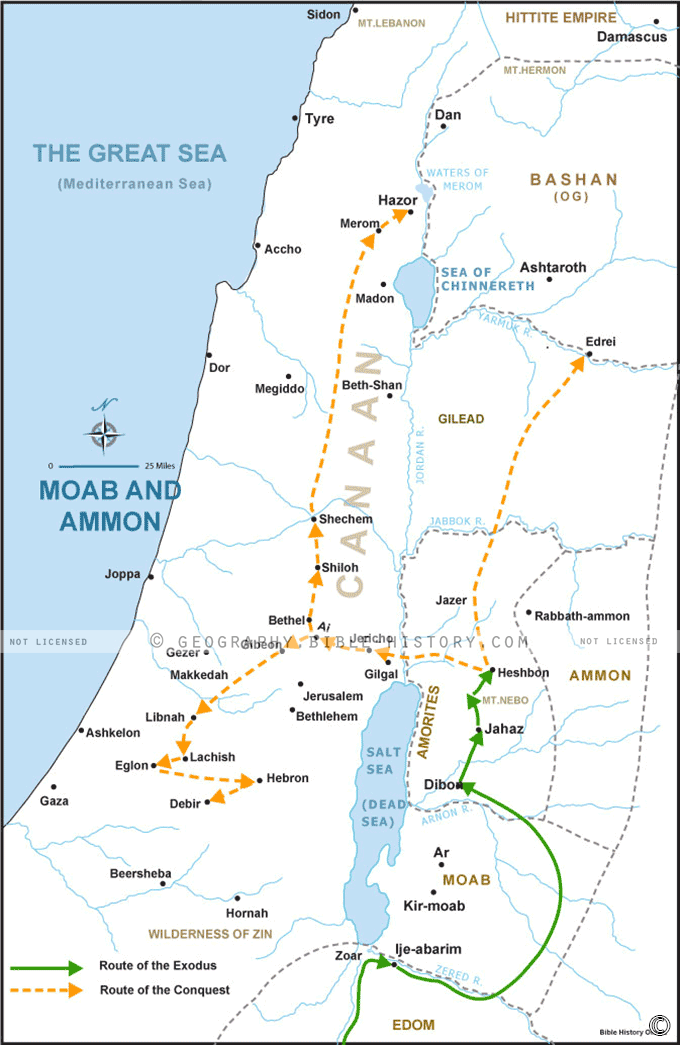
numbers_moab_and_ammonNumbers 21 tells of the attack by the King of Aram and his defeat and utter destruction.  Once again, the Israelites become upset with their long journey before they can enter Canaan.  This causes Jehovah to send poisonous snakes to kill them.  On God’s instructions, Moses makes a statue of a snake and places it on a pole.  All the people must do is look at it and they will be rescued.
They went on until they came to Ammon.  They requested to pass through and once again were refused permission.  This time they attacked and defeated the Amorites and occupied their territory.  When Og of Bashan heard they were coming, he also attacked, and Yahweh gave victory again.  This area was also taken by Moses and his people.

If you like Doctor Doolittle or cartoons with talking animals, you will enjoy Numbers 22.  Balaam’s donkey talks.  Yes, you read it correctly.  An animal in the Bible talks to its owner.  Balak was the king of Moab.  The Moabites become one of the nations around Israel that is a constant bother.  Balak was afraid of Moses and the Jews.

He sent to the Euphrates River for Balaam who was a seer or a prophet.  Unlike most foreign prophets, he knew Jehovah, the creator.  Balaam refuses to return to Moab at first after consulting Yahweh.  This is repeated and Balaam starts for Balak’s home.  This is where the donkey prevents a messenger of the Lord from killing Balaam but gets beaten for his trouble.  God opens the animal’s mouth and allows him to talk to his master.

The burrow makes some good points with his owner before God allows Balaam to see the angel.  Christians often do the same thing when a brother or sister sees danger in their actions that oppose the Lord’s will.  Often the one trying to prevent a fall from favor is abused, insulted or even accused of being holier than thou.  Many believers shy away from telling what they know because of this kind of treatment.  The story continues tomorrow.

©Copyright 2020 by Charles Kensinger

The Levites inheritance

Numbers 18 again tells of God’s instruction to Aaron that his descendants only from all the Levites may approach the altar and other holy items in the Tabernacle.  This is important and is repeated time and again.

Certain offerings are also given to the Levites as their payment for serving the Lord.  Just as we pay our Christian ministers with a certain portion of our gifts to God, the same was commanded by Jehovah.  As in that day, today ministers may not be able to live on what is given to them.  This is when either the servants or the congregants aren’t obeying Yahweh.

Levites will have no distribution of land when they reach Canaan.  They will be taken care of by God through the contributions of the people. They did not ask for this. It was God’s idea.

Purification is important to the Jews.  Numbers 19 instructs how to use a red bull to provide ashes used in many of the purification ceremonies.  For the Hebrews cleanliness is godliness.

Purification or ceremonial cleansing is mentioned in the New Testament when Jesus accuses the Pharisees of straining out a gnat and swallowing a camel.  One of the many jokes Jesus tells that we will discuss when we arrive there.  Be ready to laugh, unlike the Jewish leaders.

Purity, as discussed in these scriptures, deals with death and our contact with dead bodies. Jesus will later teach us to be clean spiritually by avoiding the death of disobedience to Him. He wants us to remain clean in spirit by refraining from the activities that He tells us to stay away from. We will see these in the New Testament.

Has God ever done something for you?  Did you show your gratitude or were you like the Israelites in Numbers 20?  Miriam has died.  While Moses and Aaron are dealing with this, rebellion breaks out again.  Moses’ anger is shown when he strikes a rock to bring water, rather than just speaking to it as Jehovah told him to.

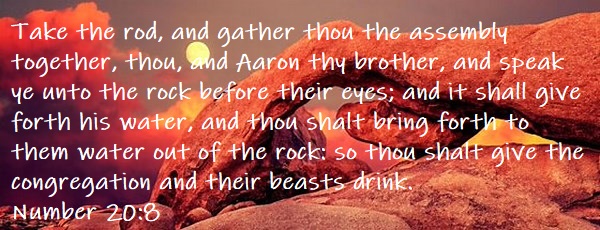
Some look at these verses and ask why Jehovah told Moses to take the staff. If He knew that Moses would be tempted to strike the rock and disobey Him, why did he tell Moses not to bring the rod?Numbers 20 8 To allow us to make our own decisions based on our free will God must give us the latitude to make our own decisions. When He removes the opportunity for temptation, His power cannot be revealed to us as He helps us avoid disobedience.

Aaron and Moses are refused entrance into the holy land because of this.  Then Edom restricts passage through their land.  The Israelites turn around.  To add insult to injury, Aaron passes away.  The forty years of wandering is spent burying those who refused to conquer the land the first time they had the chance. The mourning for Aaron lasted thirty days.

©Copyright 2020 by Charles Kensinger

Who is called to be God’s spokesman?

Numbers 16 13

Numbers 16 tells the story of Korah and his followers who challenged Jehovah.  The controversy appears to involve Aaron as the father of the priestly line.  The disagreement is over what God has commanded.  Often, we challenge those who claim to speak for the Lord.  Moses’ plan for a confrontation to determine the true will of Yahweh is wise.  Korah’s actions are not.

Incense is to only be burned by the priests.  These Levites can serve in the sanctuary, but only Aaron’s family serve as priests.  Korah, Dathan, and Abiram have the audacity to oppose God, but not the courage to face Moses and the Lord.  When the earth swallows these men, their families, all they own and the other 250 Levites which burned incense, the other Israelites should learn.  They do not.  Over 14,000 more die from a disease before Aaron puts himself in danger and stops the plague.

Another test of Jehovah’s will is discussed in Numbers 17.  Moses has a leader for each tribe bring a staff to him.  Guess what, all these shepherds have one.  God instructs them to be left next to the ark overnight.  What kind of wood are these made of?  Aaron’s at least was almond wood.  How do we know?  It sprouted, budded, blossomed and produced almonds.

They left it there to prove to everyone which tribe was chosen to lead the worship in and around the Tabernacle.  This terrified the Israelites because they believed they would die if they did something that Jehovah did not approve of.  Parents often feel this with their children.  They frighten them without intending it to happen.  Yahweh knew it would happen.  Sometimes fear can be an effective motivator.

©Copyright 2020 by Charles Kensinger

40 years on the road

On The Road Again 001Numbers 14 continues the story from yesterday.  The people react hysterically and want to replace Moses and Aaron as their leaders.  Despite that, they prostrate themselves before Jehovah and beg Him to forgive the Israelites.

It seems amazing in our day that they would not trust Yahweh after all the plagues, the parting of the sea, the water from the stone and the other wonders He performed to prove He was powerful.  Have you ever said or done something stupid and then tried to correct it by being even more ignorant?  That’s what they did.

After God pronounces judgment on their sin, they are remorseful and want to avoid the punishment of wandering in the wilderness for forty years.  They set out into Canaan and are repelled by the current residents.  Will forty years strengthen the faith of the Israelites?

Once again in Numbers 15, they are again instructed in the procedure for sacrifices.  Sacrifice is key to the forgiveness of our sins.  Read each paragraph and think about the death of God’s ultimate sacrifice after thousands of years of temporary solutions.

Unintentional sin is dealt with by sacrifice.  Intentional sin will cause ostracism from the congregation.  Today we celebrate the forgiveness of Jehovah by forgiving the shortcomings of others.  The next story emphasizes this difference.

A man is discovered doing a simple job on the Sabbath and God’s instruction is to stone him.  All sin is serious to the Lord.  Every one of us has done something worthy of death.  As we go through the laws again, notice the ones you are guilty of and remember the punishment they carried.

Tassels seem to be something silly to be given as a reminder of the law.  God wants us to use the simple to remind us that we are sinners and only He could solve this problem.

Moses writes to us in chapter ninety of Psalms. Time means nothing to Yahweh. The lifespan of humans is nothing to Him. Seventy or eighty years is the best we can muster against His eternal existence. We must count our days and respect the small amount of time we have here. It is up to Him to make our work here valid and useful.

©Copyright 2020 by Charles Kensinger