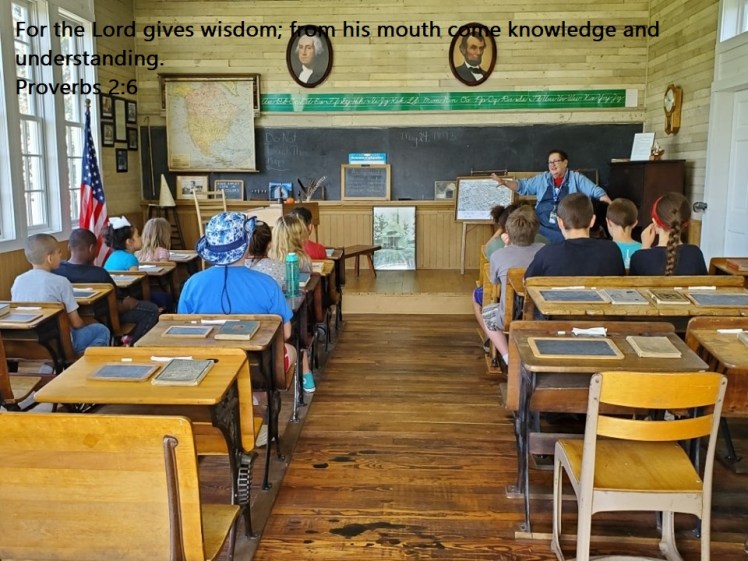
Wisdom for women

Go back to the last few days and reread those comments. Many of the Proverbs in chapter 13 deal with the same topics. The New Testament warns us of the problems our tongues can cause. So, does Proverbs.
Hope is another idea embraced here. Fulfilled hopes give us life. Dashed desires bring depression. The wants of good people will be delivered, but those who are only serving themselves will be disappointed.

These Proverbs speak mostly to men. but in Chapter fourteen we read about the wise and the foolish woman. Sharing our joy and heartache is mentioned in verse ten. Sometimes, what we think is right leads to death. The patient will have an understanding.

Our response affects what happens to us. Our mouths are used for the destruction of others and ourselves or to help. Proverbs 15 tells us this and that Jehovah watches all of us. Do you believe this? If so, shouldn’t you worry about what He feels about your words and actions?

©Copyright 2020 by Charles Kensinger

What is your path?

Proverbs 10 gives us many different sayings. We will look at a few of them. Getting something without working for it is worthless. Hard work is its own reward. Walk in integrity and you will be secure. Love covers up our sins. This means that God’s love from His Son will blot them out.

Many things are said about the righteous. They will not go hungry. They are blessed by Jehovah. Life comes from right living. They delight in wisdom. Solomon contradicts the saying “Only the good die young” in verse twenty-seven. The contradictory phrases make it easier to understand.

We are looking at dualities and opposites again in Proverbs 11. Let’s talk about what this chapter says about wealth. Good decisions on helping others financially can be hard to make. Look at the different examples that are given.

Jehovah and man are another topic that is discussed. We should not place our hope in mankind but in the Lord. Often it appears that our relationship with Yahweh can be seen in how we respond to others around us.

Do you love discipline? In Proverbs 12, it calls the person who hates correction stupid. Don’t chase fantasies. Be faithful to try to improve yourself with the guidance of Christ. Pay attention to what people advise you to do. They may have something constructive to say.

We see many comparisons of the wicked and the righteous. How can you judge wickedness and righteousness? By their deceitfulness or honesty in advice. Our words are also an indicator of whether we obey God or seek our own profit.

©Copyright 2020 by Charles Kensinger

The temptation of sex

Why is he hung up on sex again in chapter seven of Proverbs? Because the misuse of it can ruin your life. Look at the description of the woman, the comments she makes, and the lies she tells. Ladies just reverse the sex of the tempter and you will be caught in the trap as well.

Does wisdom call out to us as Solomon asks in Proverbs chapter 8? Have you ever had a decision to make and someone gave you the advice you did not take? If the choice was the wrong one, you ignored the voice of wisdom. How do we know it is wise? It is the truth and will add to your life. Good decisions provide wealth, honor, and righteousness.

Jehovah created wisdom. Before the universe or the earth came to be, wise words existed. When it came about is not important. The fact that it was made by Yahweh is.

What are the simple ways that are spoken of in Proverbs 9? Would you like to know if you are wise or a mocker? Verse eight says that a mocker will hate those who rebuke them, but a wise man will love them.

“The fear of the Lord is the beginning of wisdom.”  When we speak of fearing God, it is more respect than terror brought on by an evil master. We know that life is hard but living it with God will make it easier.

©Copyright 2020 by Charles Kensinger

Following a father’s example

Proverbs 4 6As fathers, we want our children to learn from our mistakes. In Proverbs 4, King Solomon encourages his sons to follow his advice. He learned from his father and the process continues. He recounts the advantages of wisdom and understanding.

There is a way that is correct and one that is evil. Most of us want to be the type of man or woman the does right. We err sometimes without intending to. Some intentionally cause problems for others for their own gain of pleasure. Our actions grow from what is inside of us. We can ask Jehovah for wisdom to become the servants we should be or follow selfish desires that make us useless to others.

The free love movement has been around for over a century. You may think it began in the 1960s. There were proponents of sex without marriage since man was created. In Proverbs 5 young men are taught to listen to the instructions of a wise man to avoid adulterous relationships. Remember that this is the man that had 700 wives and 300 concubines. U.S. law only allows one sexual partner, husband or wife, at a time. Even these laws have been modified to the point that sexual promiscuity is no longer illegal.

As parents, we must teach our young men and women to remain faithful until they are married. read the reasons that are given here. If you do not believe Solomon and I, ask those who have lived this lifestyle of lust and now regret it.

Finances are a problem for many of us and in Proverbs 6 Solomon advises us to remove ourselves from obligations to others. Working to release ourselves from debt is what is advocated. Laziness is mentioned a lot in the book of Proverbs. The example given here is the ant. They work hard and enjoy the fruits of their labors only after the job is complete. The movie Ants depicts this concept through animation.

Next, we turn to the wicked. Are you a troublemaker? Do you plot evil? Do you stir up conflict? If so, you are in for a disaster. Seven things to avoid, a smart mouth, a lying tongue, hurting others, thinking up evil acts, running to commit those evil deeds, being a false witness, and stirring up conflict.

How bad is sexual sin, especially adultery? According to our culture, it isn’t a big deal. Share sex with anyone you want. One of the comparisons given is a man walking on hot coals. Hindu wise men pride themselves in this practice. If you can train your body to do this, then you can commit adultery, right? Wrong. Your feet aren’t what her husband will destroy.

©Copyright 2020 by Charles Kensinger

The wisdom of the proverbs

Proverbs 2 6A proverb is a wise saying and as we begin in Proverbs 1, we see that Solomon, the son of David, King of Israel is our author or editor. The purpose of this book is to gain wisdom and insight and receive instruction in prudent behavior. We can all learn something from this book, no matter our age or intelligence level.

Many things are covered in this book and like much of the Bible, there is a lot of repetition. As we read, I will attempt to not repeat, and each day try to find some new morsels for you to digest. The first being, that the respect of the Lord is the beginning of knowledge. Following that is the instruction that it is foolish to despise wisdom and instruction.

Avoid those who attempt to draw you into actions that do not seem proper or fair to others. Wisdom wants us to follow in its footsteps and learn to be intelligent and caring. Following this route will lead to safety and contentment. When we are young, that often is not exciting enough for us.

What is the fear of the Lord? Proverbs chapter 2 says that wisdom will enable us to understand that it is not fearing what He will do, but respecting His abilities, power, and judgment. What is correct, just, and fair? Some call this common sense, others believe they act with fairness, while friends and family view them as cruel.

Have you made decisions in your life that you regret today? Have relationships gone bad, jobs turned out to be the wrong position for you, or have you alienated family or friends by incorrect choices? Wisdom from Jehovah can prevent these troubles.

When we are young, we often ignore the advice of parents and older friends and family. Proverbs 3 begins with King Solomon advising his son to listen to these words of wisdom that he wishes to pass along. Love and faithfulness should be our practice all our lives. Verses five and six are two to commit to memory if you do not already know them.

In this format, every group of two verses completes a central idea. Look at a few of these. Pride, wealth, and discipline are these ideas. The chapter continues with a description of what can be gained with wisdom and understanding. It concludes with another series of paired comments that illustrate how a wise individual will treat others. A fool is the opposite of a wise person.

©Copyright 2020 by Charles Kensinger

Solomon’s song of Lust

Song of Solomon 1 4

To continue our study of King Solomon we move to the Song of Solomon chapter one. This book is one of sexuality, pure and simple. Jehovah made us as sexual beings. Why shouldn’t there be a book in the Bible that exalts sex? Don’t believe that this is a poem of love. It is about lust. Eros, that is translated as love is the focus. It should be translated as lust. Agape is the true word for Godly love.

She is completely willing to succumb to the King’s desires. We do not know who the woman is in these verses. She may be one of his wives, concubines, or some other young lady with whom the King was infatuated. As all lovers do, they are looking for a rendezvous, where they can be alone.

The two romantics have nothing but compliments for each other. Those around them encourage their amorous feelings. The metaphors used here are often interesting. Think about the description of her eyes as doves. I don’t think I would use that as a pick-up line.

We often describe a woman as a flower. In Song of Solomon 2, she describes herself as a lily of the valley or rose of Sharon. He responds that she is a Lilly among thorns. To describe the young King, she refers to him as an apple tree in the forest. This is like the Lilly among the thorns. Both are viewed as special by their lover.

A good piece of advice is given by the woman. Do not awaken your lust until you are ready. It is spring and in the spring all the animals want to reproduce. Shouldn’t humans fall to the same desires? The short answer from her is, no. He does not listen but encourages her to run away with him.

Our heroine wakes and goes into the streets in Song of Solomon 3. She searches and asks for the one she desires and returns home with him. Then she reminds young women to be careful about allowing their sexual desires to take over their thoughts at too early an age.

She then sings the praises of the King as he approaches in his carriage. The phrase, “he is wearing the crown with which his mother crowned him on the day of his wedding.” Note she says, “his wedding,” not our wedding. That means she was one of the seven hundred, three hundred, or just another lover of the King.

We return to descriptive phrases in Song of Solomon 4. Eyes like doves, hair-like goats, teeth like a flock of sheep, lips like a scarlet ribbon, a neck like a tower, and breasts like twin fawns may not make sense to the modern mind, but he calls her “altogether beautiful.”

He is smitten. She has stolen his heart. Her perfume and her body have enchanted him. He calls her a garden fountain and she replies to the wind to blow the fragrance of her garden to her lover. She asks him to come into her garden and taste her fruits.

We continue in Song of Solomon 5 with the garden and the friends encourage them to eat and drink together. Let your mind guide you as to what that could mean.

She awakes to find him gone. She searches for him but cannot locate her desired one. How is your beloved better than others? Is he radiant, ruddy, or outstanding? Now he has doves for eyes. Most importantly, he is her friend, not just her beloved.

Once again, our lovers are separated in Song of Solomon chapter 6. We read those descriptive phrases about the flocks of goats and sheep and pomegranates. This had to be early in Solomon’s life because he speaks of sixty queens and only eighty concubines and calls her one of a kind. Here she is referred to as a Shulamite while the King searches for her.

Would you like some more metaphors from the King? Song of Solomon 7 tells us her legs are like jewels in an artist’s hands, her naval like a rounded goblet, her neck like an ivory tower, hair like a tapestry, and stature like a palm. I’m not sure that a waist like a mound of wheat should be a compliment. The sensuality of breasts like clusters of grapes, breath like apples, and a mouth like wine is unmistakable.

She accepts these praises and suggests another rendezvous in the country. Their passions will be kindled again in a place they can be alone.

Repetition in poetry to emphasize important thoughts is used again in Song of Solomon 8. The last chapter of this book repeats the lines “His left arm is under my head and his right arm embraces me. Daughters of Jerusalem, I charge you: Do not arouse or awaken love until it so desires.”

Love is compared to death and jealousy to the grave. Love or sexual desire cannot be quenched. Young girls are still married to older men in many of the Arabic lands as is mentioned in verse 9. We end the love story with them together in the same ecstasy that began this book.

©Copyright 2020 by Charles Kensinger

Solomon chooses wisdom

To have the alliances necessary to remain in peace, Solomon formed treaties with other nations. In 1 Kings 3 we are told of his marriage to the daughter of the Pharaoh, the king of Egypt.

After sacrificing at Gibeon, Jehovah appears to him in a dream and asks what he could give to the new King. Discernment or wisdom to govern the people is the request. There is a requirement included. He must walk in obedience as David had.

The chapter ends with a story about two prostitutes that lived together, and both had babies. We know how the King solved this dilemma and it proves his wisdom. Tomorrow we will read another version of these events.

First Kings chapter four starts with all the officials of Solomon’s kingdom. The amount of provisions needed for feeding his court is also included. It ends with a description of his wisdom and knowledge. I have always had a problem with the third King of Israel being classifies as the wisest man in the Bible. While God gave him insight that made him a great ruler, I believe a man of true wisdom from Yahweh would have not allowed his wives to continue to worship idols. Many Christians have their idols. We call this king wise when his tolerance of idolatry was foolish. When we reach Proverbs, we will see how he contrasts the wise and the fool. We’ll compare what he said with his actions.

We will look at the differences recorded in 2 Chronicles 1 from how it was told in 1 Kings three. Solomon goes to sacrifice to Yahweh and is asked what he would like most. The answer is the same. He asked for wisdom to rule the Israelites. This version includes no reference to Pharaoh’s daughter or the tale of the prostitutes and their babies.

The emphasis in both accounts is on Jehovah giving The King more wisdom than anyone ever had or would have. No mention is made here about the requirement to obey His laws. More time is given to the collection of wealth and possessions.

Solomon is the author of the 72nd Psalm. It is almost like a prayer that he voices to God for his kingdom. Righteousness, prosperity, endurance, expansion, and tribute are things he requests of Jehovah. Some of these aspirations almost sound selfish. Nothing is said about wisdom.

©Copyright 2020 by Charles Kensinger

The death of a king

Medical practices have changed a lot since the period written about in the first book of the Kings of Israel. Chapter one begins with the elderly King David needing some aid to stay warm while sleeping.  Electric blankets and space heaters had not been invented yet.  Abishag, a young unmarried woman is brought in to be a human hot water bottle.  This problem with old age sets the stage for a coup.

We have finally finished the material about and by David. In 1 Kings 1, we begin to look at the third king of Israel, Solomon. David is still alive, and his second-oldest son makes a play to become the ruler of the Jews. The shepherd king is old and feeble. A young woman is found to share his bed to keep him warm. Talk about a live hot water bottle. She will be significant later.

David’s son, Adonijah, decided to promote himself as king. Joab supported him.  As the next oldest to Absalom, he felt he should be the successor.  No one told him he was next in line. As many of us do, he considered it was easier to ask forgiveness than permission. He even invited all of his brothers except Solomon to the coronation.

Nathan was not invited, either. He went to Bathsheba and asked her to go to see her husband about his wishes for an heir to the throne.  This triggers a ceremony to put Solomon on the throne before there is a battle between brothers. When word reaches Adonimah, the party is over.  He runs to the altar and pleads that Solomon will not take revenge on him for trying to grab his Jehovah granted position. Solomon agrees to forgive him if he is faithful to the new king.  That’s not going to happen.

Adonijah uses Joab and Abiathar to help promote his place as the next ruler. The problem is that Yahweh had told David a son by Bathsheba would succeed him. Remember the prophet Nathan that confronted David about his sin with her? He works with her to move Solomon in as the current leader’s true choice.

His older brother goes to the altar in the tent of meeting and holds onto the horns until he has the new King’s pledge not to kill him. Execution of family members is common to secure your place as a monarch.

©Copyright 2020 by Charles Kensinger

Solomon is installed as king

David not only had Solomon installed as king before he died in 1 Chronicles 23 he also established the service of the Levitical families. They had all the needed functions of the Tabernacle covered. Some were musicians, gatekeepers, in charge of all the different kinds of festivals, and sacrifices. These families would continue these duties after the Temple is built by Solomon.

The book of 1st Chronicles is very interesting in the way it tells the same stories as other books. One example in chapter twenty-four is the way Aaron’s oldest two sons died. No specifics are given, but we know from Exodus that their deaths were in response to disobedience. We are given the genealogical divisions for work in the Tabernacle and eventually the Temple.

Of course, David would appoint some of the Levites as musicians. The prophets mentioned in 1 Chronicles 25 are most likely what we know as Cantors. They would chant or sing the words of the Psalms during worship. The accompaniment by the lyres, harps, and cymbals is also assigned by the King. Two-hundred and eighty-eight men from the line of Levi are selected for their positions by Jehovah.

©Copyright 2020 by Charles Kensinger