
Not Sarai’s son

Baby 001Genesis 16 tells Sarai’s idea of how they could have a child.  It was in common use in their culture.  As our times and current popular opinions often lead us in directions God would not approve Abram and Sarai made a similar mistake.  A child by another woman was not in Jehovah’s perfect will.

This hiccup did not surprise Him.  His promise of the number of people groups that would come from the Patriarch is increased even more through Ishmael.  While this was not the original plan it did not destroy God’s goal.  Often, we delay God, but can never derail Him.

In Genesis seventeen we are introduced to circumcision as a symbol of nationality.   Even today Hebrew males have their foreskin removed eight days after their birth.  The ceremony is called a bris.  It is equivalent to the Baptism of babies in certain Christian denominations.  Without it, your son will not be part of the inheritance of Abraham.

God also changes Abram’s name from Exalted Father to Father of Many.  This is also the chapter where Sarah’s name is changed, and God includes her in the biological lineage of the nations and kings to come.

The name of the child to carry the covenant is interesting. Isaac means He Laughs. Every time Abraham and Sarah called their son, they would be reminded of the fact they thought this child being born was laughable.

We’ve arrived in chapter 18 of the first book in the Old Testament. Abraham sees three men coming towards his tent. He implores them to stop and eat with him. They stayed for several hours. Long enough to butcher and cook a calf. This is a much longer process than thawing steak in the microwave.

Some believe this was an early incarnation of Jesus with two angels. Others view the three as representing the triune Godhead. The Lord announces that the child will be born within a year. This time, it is Sarah’s turn to laugh at the idea.

The purpose of the visit is to warn Lot and Abraham that Sodom and Gomorrah will be destroyed. Abraham convinces God not to follow through if only ten righteous people can be found. This story continues tomorrow.
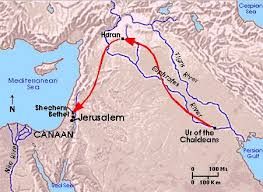

Abram’s travel plans

Map of the Middle East 002

Genesis chapter 12 is what we will read today. We are continuing to follow the chronological order. God’s instruction to Abram was to go to a land that He would show him.  Anyone want to make travel plans this way?  Promises are made to him.  Blessings and cursing would be dependent on him.

Being called by God does not guarantee that all our decisions will be good.  The story of Abram telling Sarai to lie about being his wife does not seem to indicate his honesty and desire to protect his wife.   God protected Sarai when her husband would not.  God often protects us from ourselves.  Currently, Abram was not a man of faith in Jehovah.

The story of nephew Lot begins here in Genesis chapter thirteen.  Lot and Abram both had large flocks and herds.  As nomads, they constantly moved around to find new grazing grounds.  Their shepherds and herdsmen were fighting over the best grass.

Previous incidents did not demonstrate any Godly wisdom from the Patriarch.  However, this time he approaches the situation with much discernment.  He allows Lot to choose which direction to go.  There is no bad ground here.  Only good, better or best.  To the human mind, Abram goes to the wrong area.  It is not the best.  We’ll talk about this when we read other chapters.

God promised to fill all the land around Abram with his offspring.  This included where Lot had gone.  Jehovah always remembers His promises.

Our story starts with a war that involved Abram’s nephew Lot in Chapter fourteen of Genesis.  His side is defeated, and his uncle comes to their aid.  The smaller force is successful in recovering property and freeing Lot and others including women.

Abram gives the priest of Salem a tithe of the proceeds from the rescue.  Melchizedek is honored and blesses Abram.  Apparently, he is a worshiper of Jehovah.  The Patriarch also refuses to accept profit from the King of Sodom for the rescue.  This is one of Lot’s first problems with his choice of place to reside.

Melchizedek has a short scene here. In Paul’s writings, we read that Christ is a priest on the order of this man. He predates the Aaronic priesthood. He is different from what we normally think of as a priest of Yahweh.

Jehovah makes an everlasting covenant or agreement with Abram today in Genesis chapter fifteen. The method of securing a legal agreement was by splitting animals and laying them out in a manner where you could pass between the two halves. The animals were laid out and a firepot representing God passes through. Abram believes and it was counted as faith. He still was not perfect but did believe that this promise would be kept. That is all God wants us to do. Believe Him one step at a time.

©Copyright 2020 by Charles Kensinger

I’m sorry Yahweh

Jehovah tells Job to answer Him in chapter forty. Job replies by apologizing. He decides that he has said enough. “Would you discredit my justice?” is another question that Jehovah asks of us. Sometimes we do want to argue that He is not always just, but that is because we think He is being unfair to us or someone we care about. Like Job, God may not be the one that is responsible for the actions that we blame on Him.

What is a Behemoth or a Leviathan? They are described here. They do not sound like anything I have seen in a zoo, but they resemble the reconstructed dinosaurs that are in some museums. This is a reason why this book is dated just after the flood. The creatures are now extinct but did exist at one time. The words about Leviathan take up all of chapter forty-one. Look at these two descriptions and decide if you know what they could be.

Job acknowledges again in chapter forty-two that God can do all things and that he did not know what he was talking about when he questioned His motives and actions. This story has a happy ending when Job’s friends are put in their place and Job prays for them. Job’s fortune is restored, and he and his wife are blessed with more children, seven sons, and three daughters. He lived another one hundred and forty years. His life was not cut short.

What Jehovah has to say

I Am God

We and Job have been waiting for this and now, in chapter thirty-eight, we wish we were not included in what God has to say. Job did speak without knowledge. He accused Jehovah of punishing him unfairly. We know that it was Satan that inflicted this pain on him. All the questions that He asks are valid. We do not know any of these answers. Sarcasm can be from Yahweh as He shows us in verse twenty-one. In verses thirty-one through thirty-three He speaks of stars and constellations. What are the laws of the heavens that is spoken of here? Many of their movements are understood better now than in previous times.

Wild animals that are mentioned in chapter thirty-nine are now monitored by conservation groups. This did not happen in Job’s time. Many wild animals are captured and tamed in the modern world. Men can learn some of these facts about the wild animals, but most of us are ignorant of them. The wisdom of the Lord is beyond us. Job has been put in his place.

It’s not my fault

Job argued that he had done nothing to deserve the treatment he was being given. In chapter thirty-five Elihu states that he said he was right, not God. That is not the way I read it. Does our sin effect the Lord? This could be answered no, or it might be yes. Many do not think that Jehovah cares about us. He cared enough to come as a baby and die for us. He then loved us enough to conquer death for us.

Our wickedness or righteousness does matter to other people, but God also cares. He says that no one cries out to Yahweh, but we do. He does listen to us. He even hears the wicked when they cry out in repentance. Job’s mouth is full of empty words according to Elihu, but it seems the empty words come from him, not Job. His ignorance comes from a lack of knowledge of God because he did not have our Bible.

His knowledge comes from afar according to chapter thirty-six. He claims perfect knowledge and will ascribe justice to the Maker. According to him, God tells us what we have done to deserve our distress. This is not true. He doesn’t always do this. Obedience is not a guarantee of prosperity. Some today use the reverse of this. If someone is wealthy, God must be pleased with them.

We have a saying, “Only the good die young.” He believed that the wicked died young. Both sayings are incorrect. The good and the bad may live long lives or not. God’s ways are not ours and we do not truly know who He is.

The thunder is supposed to be the voice of the Almighty in chapter thirty-seven and we know that he spoke in a still small voice at least once in the Bible. He does come in awesome majesty, but not out of the North.

©Copyright 2020 by Charles Kensinger

The young teach the old

https://learningenglish.voanews.com/embed/player/0/2452803.html?type=video

A fourth accuser has been sitting and waiting for the opportunity to speak his mind. In chapter thirty-two he begins his discourse. Elihu is younger than all the others. He believes he has more wisdom than the others and is determined to share his thoughts. He agrees with Job that his guilt has not been proven and disagrees with the others that Yahweh should judge, not them. He believes he knows the truth and will share it.

He seems to be awfully full of himself in chapter thirty-three. He believes, as the others have stated, that his position is the proof that Job has sinned. Just as God speaks through dreams and other means, so he voices His viewpoint through His actions. The Lord will restore those who admit their sin and ask for forgiveness. He offers to teach Job wisdom.

In Job 34 Elihu includes all of them in his offer of instruction. Youth do not know foolish they look when they try to prove their intelligence and prove they are wiser than their elders. His arguments are well formed, but they are not better than those used previously by the others. “Job speaks without knowledge.”

The “Good Old Days”

1987_AMC_Eagle_LI

As Job makes his final argument in chapter twenty-nine, he longs for the days that were. Any of us who are going through difficulties would want to return to the good times. We may feel that God is no longer with us, but we are mistaken. In those days he was a leader and had respect. This was because of what he was able to do for others. With his wealth and health gone, this was not possible anymore.

Now, in chapter thirty, he is thought to be insignificant. He is mocked and looked down on. The way to build yourself up is to tear others down. That is still what many do today. They do not take pity on the week or underprivileged. As Job feels his life ebbing away, He pleads with Jehovah to cover him like a garment. He continues to believe that God is after him. His disease has blackened his skin. He burns up with fever and music is only a funeral dirge.

Chapter thirty-one begins with the covenant Job made with his God. We are watched by Him and must agree to follow His plan. Job agrees that what his accusers have been saying is true. If he has not been righteous before Jehovah as he claims, then the punishment he has been given is appropriate.

©Copyright 2020 by Charles Kensinger

For such a worm as I

Worm 001

Job continues in chapter twenty-four with his answer to Eliphaz. We know that judgment is scheduled after our death. Job lists a lot of the same types of things he is accused of. Light and darkness are at war. Who can prove Job’s words to be false?

Bildad replies briefly in the twenty-fifth chapter that God has dominion. He asks how we can be righteous before Jehovah. He also calls Job a maggot or a worm.

Job is not pleased with this characterization and responds in chapter twenty-six. He sarcastically speaks of all Bildad’s accomplishments for the powerless and feeble. He continues to give a list of Yahweh’s strength and power.

He continues to refuse to sink to the level of his accusers in chapter 27. He will remain faithful to the Lord. He hopes his enemy is like the wicked and the godless. He offers to teach them about his God which seems to be different from theirs. He tells what the wicked will suffer while maintaining his innocence.

In chapter twenty-eight Job continues to teach them about wisdom from God. Wisdom and knowledge cannot be mined or dug from the earth like other precious minerals and metals. It can’t be purchased. Where does it come from? “The fear of the Lord-that is wisdom.”

©Copyright 2020 by Charles KensingerWorm 001

Patience is as patience does

The Patirnce of Job.jpg

Job replies to Zophar in chapter twenty-one. His consolation could just be listening to him. “Why should I not be impatient?” Wait a minute, what about the patience of Job? All my life I have heard people say they wish they had the patience of Job-like it was something to be desired. He declares that he is not patient.

He lists all the things that seem unfair to him for wicked people to enjoy. These are the same things that his three friends say do not happen. God does not bless the evil ones, but our hero believes that He does. Why? Remember that Job is the only one that Jehovah called to the attention of Satan. These other men are not on the same level of righteousness as these. He does not understand why God would publish the children for the sins of the fathers. He considers all his friend’s answers as falsehood.

Eliphaz speaks again in chapter twenty-two. Are we beneficial to God? If we aren’t, why did He create humans? Does it please Him if we obey or disappoint Him if we do not? Of course, He is pleased by our positive actions. Look at the accusations that are made. Demanding security, stripping people and leaving them naked, and refusing water and food to those who need it. He is using reverse reasoning to prove that he is correct.

Chapter twenty-three has Job’s reply to Eliphaz. He will meet with God and voice his arguments. If he could do this, his innocence could be seen. He can’t find the Lord. The power of Jehovah is not in doubt to Job. This terrifies him.

©Copyright 2020 by Charles Kensinger

Pride and ignorance

Image result for ignorance and pride quotes"

The hostility of his detractors is primary in Job 17. Job views them as having closed minds. He again describes the problems caused by his health issues. His grief is intense. He still has dreams, but the hope is difficult to see.

Bildad does not understand why his friend views him as ignorant and refuses to listen to them. He answers his own question in chapter 18, by commenting that God would snuff out the life of the wicked. Job has not died. Jehovah must therefore not believe him to be evil. Bildad’s list of things that would happen to the wicked is long. He seems not to notice the number of items on this list that do not apply to Job.

Job replies to him in chapter 19 when he says that their words have crushed him. He does not need one more thing that adds to his discomfort. Once again, he voices that he has been wronged by God. That is not true. Yahweh has not been the one that caused his family and friends to desert him. In spite of his feeling that God is against him, he still declares that his redeemer lives and his life will be redeemed.

Zophar speaks again in chapter 20. Pride is a fault he attributes to the godless. According to his faith, this includes his friend who has had such misfortune. He speaks of the wealth and plenty of the wicked but does not remember that all of Job’s wealth is gone. If God destroys those he has rejected, why is Job still alive?

©Copyright 2019 by Charles Kensinger